


What began as complaints over missing teachers, poor food and inadequate school facilities is increasingly spilling onto the streets, with schoolchildren across several states organising protests, marches and sit-ins to demand basic amenities and accountability.
They have marched to government offices, blocked roads, locked school gates and staged sit-ins over demands ranging from teachers and clean water to food, toilets and better roads.
The immediate triggers are mostly basic. But the emerging pattern raises a larger question: why are children who are too young to vote increasingly choosing public protest to make themselves heard?
The protests also come against the backdrop of highly visible Gen Z-led movements and growing social-media-driven activism. In some cases, students appear to have been directly inspired by earlier NEET paper leak protest and the Jharkhand student protests.
Rise of Gen Alpha protests: Why are children taking to the streets?
The recent demonstrations span different states and different schools, but the underlying complaints are strikingly similar.
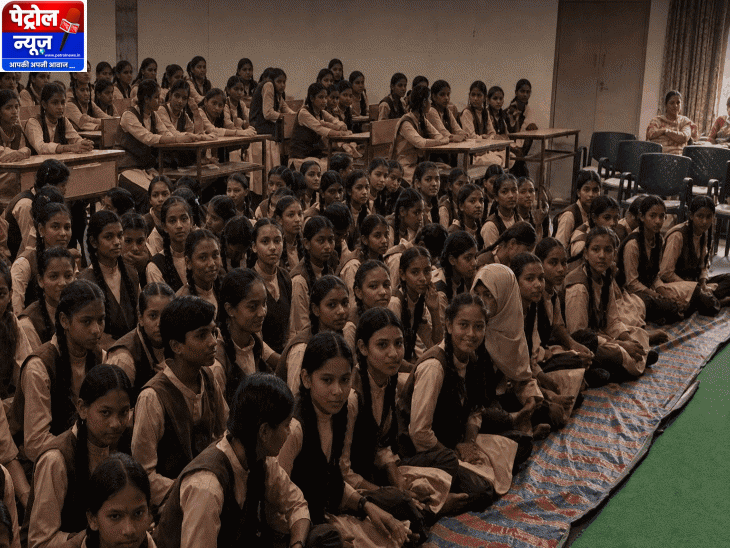
In Lucknow, around 250 girls from a government-run Sarvodaya residential school walked nearly 2.5 km in heavy rain and blocked the Dubagga-Kanpur Bypass, demanding teachers for Physics, Chemistry and Biology. The students also complained about internet connectivity, drinking water and hostel facilities.

In Unnao, more than 250 students protested over teacher shortages, poor-quality hostel food and inadequate facilities, refusing to leave until senior officials intervened.
In Fatehpur, around 1,500 students protested against broken fans, poor sanitation, contaminated water, inadequate desks and the absence of a library, computer lab and sports facilities.
In Gaya, students walked to the SDM’s office over poor midday meals, broken benches, dirty toilets and a dysfunctional hand pump.
And in Jalore, Rajasthan, girl students locked their school gate and staged a dharna over vacant teaching posts. The protest ended after the administration assured them that four teachers would be appointed immediately and three more would be called within 10 days.

Students sitting in front of the school gate in Jalore, Rajasthan
The common thread is therefore not a political ideology. It is the demand for basic conditions in which children can study.
From poor facilities to teacher shortages: What are children protesting about?
The demands emerging from these protests largely fall into four categories: teachers, infrastructure, food and basic safety/access.
Teacher shortages are among the most recurring complaints. Students say vacant posts are affecting their studies, particularly those preparing for board examinations.
Infrastructure is another major concern. Children have complained about classrooms without working fans or electricity, dirty toilets, inadequate drinking water, broken benches and the absence of libraries and computer labs.
Food quality has also triggered protests, particularly in residential schools where students depend on hostel messes for their daily meals.
The complaints are not limited to school campuses. In Hamirpur, children and villagers marched to the Collectorate demanding a proper road to their school, arguing that the poor condition of the route becomes particularly difficult during the monsoon.

In Ujjain, students of Maharani Lakshmi Bai Government Girls’ Higher Secondary School protested against a proposed relocation of their school around 15 km away. Their concern was not simply about a building, but about how the move could affect their ability to continue attending school.

In other words, the protests are about access to education as much as education itself.
Why are long-standing problems turning into street protests now?
This is perhaps the central question of the emerging movement.
Teacher vacancies, poor infrastructure, inadequate food and sanitation are not new problems. In several of these schools, students say they had complained repeatedly before deciding to protest.
What appears to have changed is the response mechanism.
Instead of waiting for school authorities to act, students are increasingly going directly to district officials. In Gaya, they wanted to meet the SDM rather than speak only to junior officials. In Lucknow, students demanded that the District Magistrate come to them. In several places, they refused to end their protests until senior administrators gave assurances.
This shift was highlighted by Chandramohan Upadhyay, principal of Kalicharan PG College, who argues that the issue goes beyond poor facilities.
According to Upadhyay, democratic governance depends on accountability and dialogue. When regular communication between citizens and institutions weakens, he argues, smaller grievances can accumulate until people feel that taking to the streets is the only way to be heard.
His argument is particularly relevant to the school protests: the problem is not merely that facilities are inadequate, but that children may be losing faith that complaints through conventional channels will produce results.
The repeated administrative response to these protests may also be reinforcing that behaviour. Students have seen protests followed by inspections, inquiry committees, assurances and, in some cases, announcements of teacher appointments or infrastructure improvements.
That creates a powerful lesson: collective and visible pressure can produce a faster response than an individual complaint.
Is Gen Alpha borrowing the Gen Z protest playbook?
There are signs that at least some students are.
The recent Gen Alpha protests have emerged in an environment shaped by highly visible Gen Z activism, including protests around education, examinations and governance.
The connection is particularly direct in Fatehpur, where Class 12 student Ankur Sonkar and three classmates had participated in the Jantar Mantar movement against the NEET-UG paper leak. They later organised a protest at their own school over long-pending problems.
The issues are different, but the protest template is similar: organise collectively, move outside the institution, attract public attention and demand accountability from authorities.
Upadhyay’s comments also point to the psychological impact of recent movements. According to his assessment, protests can generate a sense of hope among young people that collective action can bring change.
That does not establish that Gen Alpha protests are centrally coordinated or directly copied from Gen Z. But the examples suggest that children are watching how the generation immediately ahead of them uses protest as a form of civic participation.
How social media is changing the way children protest
Gen Alpha is growing up in an environment where a local incident can become visible nationally within hours.
Videos of children marching, raising slogans and confronting school authorities have circulated online, bringing attention to grievances that might otherwise have remained confined to individual schools.
This gives children a form of influence despite having little formal political power.
They cannot vote. They cannot change governments through elections. But they can create visibility.
And visibility can bring administrators, politicians and education officials to the spot.
This may help explain why traditional protest methods, marches, sit-ins, slogans, placards and road blockades, are appearing among children who are still years away from becoming voters.
The social-media effect, however, should not be overstated. The material available establishes that videos have amplified some protests, but it does not establish that social media is the sole or primary cause behind the rise.
How much of these protests are really being driven by children?
The emerging movement also raises a more complicated question: are these entirely organic child-led protests?
Adults have been present at some demonstrations. In Hamirpur, an administrative official even alleged that some outside elements were bringing children to the forefront of the protest.
But the complaints themselves are concrete and directly connected to the children’s everyday lives.
Students are talking about teachers they do not have, food they are served, toilets they use, roads they travel on and examinations they are preparing for.
So while adult involvement may shape or amplify some protests, that does not automatically make the underlying grievances less genuine.
At present, the available material does not establish a single organised force behind the protests.
What does the rise of Gen Alpha protests signal for the future?
The significance of the movement may lie less in the number of protests than in what children are learning from them.
For generations, inadequate infrastructure, vacant teacher posts and poor school facilities were often treated as routine problems. The current protests suggest that at least some Gen Alpha students are increasingly unwilling to accept them as inevitable.
They are also growing up with access to far more information about what schools and public services look like elsewhere. That may be raising expectations about what their own institutions should provide.
Upadhyay’s argument points to another important factor: trust.
If children believe that institutions will listen and respond, they may use formal channels. If repeated complaints produce no visible result, protest can begin to appear more effective.
That makes the government’s response crucial.
If authorities address the underlying problems, appoint teachers, repair infrastructure, improve food and sanitation and maintain dialogue with students, the protests could become an early lesson in democratic participation.
If grievances continue to be ignored or are addressed only after roads are blocked, the opposite lesson could take hold: that institutions listen only when pressure becomes impossible to ignore.
The Gen Alpha protests, therefore, may not yet constitute a coordinated movement. But they do reveal a shift in behaviour, from complaining about problems to publicly demanding solutions.
And that may be the most important change to watch.