


40 minutes agoAuthor: Shaily Acharya

The upcoming film ‘Ramayana’ made under ₹4000 crore budget with special effects is receiving mixed responses from viewers after it’s trailer release. Some are praising the film while others are criticising it.

Nitesh Tiwari’s upcoming Ramayana stars Ranbir Kapoor as Lord Ram, Sai Pallavi as Sita, and Yash as Ravana. Other than the film cast, another thing which is being widely discussed is the VFX used in the film. It used a full-scale digital VFX, grand CGI handled by the Oscar-winning studio DNEG (Double Negative).
But do you know how the iconic TV show ‘Ramayan’ by Ramanand Sagar created special effects in the era where there was no VFX and advanced technology?

You will be surprised to know it.
The film’s VFX is being created by DNEG , the global studio known for Hollywood blockbusters such as Interstellar, Inception and Dune.
Producer Namit Malhotra has brought together international-level technology and expertise to give the film a world-class visual experience.
In an interview with NDTV, actress Indira Krishnan, who plays Kaushalya, Lord Ram’s mother, spoke about the scale of the project. She revealed that as many as 86 cameras were used during filming and praised the VFX team for handling the film’s complex scenes.
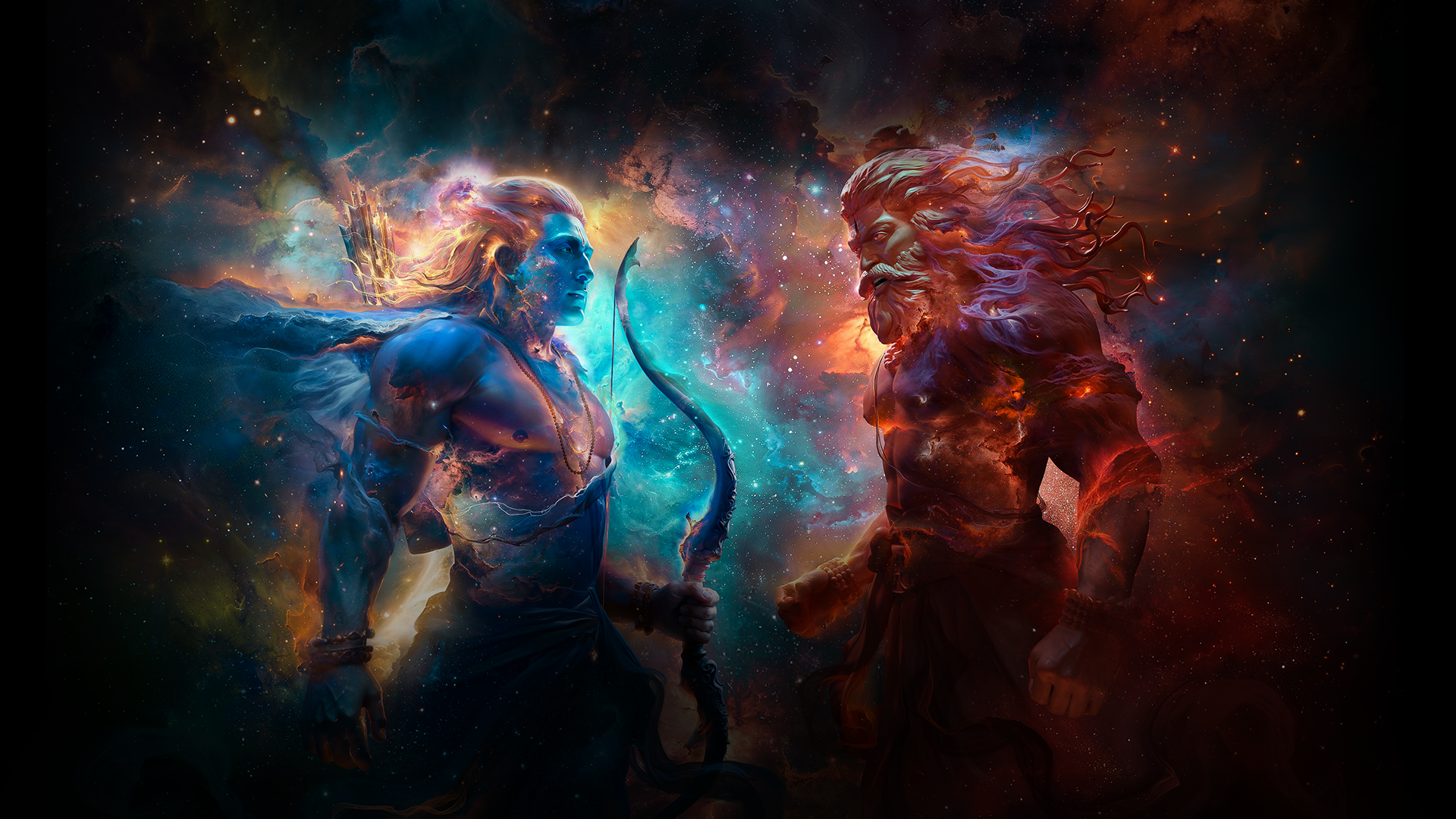
The production reportedly involves a huge budget running into thousands of crores, making Ramayana one of India’s biggest cinematic projects.
Ramanand Sagar showcased whole Ramayan without VFX in 80s
Trailers and promotional shots for the multi-part, high-budget film showcase seamless visual effects. Yet nearly four decades earlier, Ramanand Sagar’s 1987 television serial Ramayan achieved a similar cultural miracle on Doordarshan using pure ingenuity, practical “jugaad.”
POP, incense stick smoke, and cotton clouds used to create effects

The ‘jugaad’ which 80s Ramayan included wires, cotton clouds, incense smoke, plaster-of-Paris (POP) props, mirrors, and an early electronic effects machine, all on a total budget of around ₹7 crore for 78 episodes.
Each episode reportedly costed ₹9 lakh.
Here is how that landmark show was shot, and what the actors who lived through it still recall about creating magic the hard way.
Wooden sets were built in Gujarat’s Umargaon, cast lived nearly two years there

‘Ramayan’ set was built in Umargaon (also spelled Umbergaon), Gujarat. A quiet coastal town with sea, rivers, hills, greenery, and open spaces served as natural backdrops for Ayodhya, forests, Kishkindha, and other settings.
The whole cast spent nearly two years (around 550 days of shooting).
How special effects were created without advanced CGI in TV Show ‘Ramayan’? There were no computers for visual effects, limited chroma (green/blue screen had only recently become available), linear editing machines, and low-band U-matic video. Effects were created in-camera, with optical tricks, mechanical devices, and physical props:

Graphic Cedit: Aayushi Jain.
Kumbhkaran’s death scene and use of chroma technology
Sunil Lahri, who played the role of Lakshman in Ramayan, shared the details with fans in a video in 2020. He explained, “In the scene where Lord Ram battles Kumbhkaran, when Ram shoots arrows, each part of Kumbhkaran’s body like his arms, torso, and neck falls apart. These effects were created using chroma technology.”

Ramayan actors shared about the scenes and effects The iconic TV show actors have spoken about the physical hardship, simplicity, and dedication:

Dipika Chikhlia, who played Sita recalled that everything was created from available resources.
- They did their own makeup, no prosthetics or foreign specialists, designed many costumes themselves, and used coconut shells for vanars.
- For long stretches of the Ashok Vatika sequences she sat under a tree for continuity of mood, repeatedly going through Sita’s entire emotional arc.
Sunil Lahri, who played Lakshman described war scenes as fighting largely against chroma because enemy actors were often not present.
- Real arrows with sharp edges caused cuts on fingers and hands.
- Extreme heat (e.g., ~50°C in some outdoor locations) led to severe blisters and peeling skin on their backs after long days walking barefoot on hot sand.
- They continued shooting the next day after covering the injuries with makeup.

The show aired on Doordarshan starting 25 January 1987 and became a cultural phenomenon.
The enduring power of Ramanand Sagar’s version lies less in technical polish and more in the visible human effort, practical inventiveness, and the actors’ complete immersion. It remains a benchmark of what resourcefulness and devotion can achieve when technology is limited. Let’s see how the new ‘Ramayana’ would impact the audiences.