
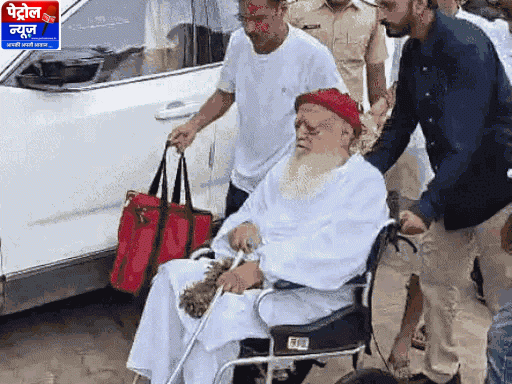


The Supreme Court on Thursday refused to grant interim bail to rape convict Asaram on health grounds, while allowing him to avail the services of a trained caretaker of his choice round the clock, according to Bar & Bench
A bench of Justices MM Sundresh and PB Varale passed the order after considering a medical report submitted by the All India Institute of Medical Sciences (AIIMS), which stated that although Asaram did not require hospitalisation, he may need continuous medical assistance.
The court also granted him liberty to mention the matter again if his health deteriorates.
AIIMS report forms basis of order
The court’s decision followed an AIIMS medical evaluation ordered on July 21, when it directed the institute to constitute a team of doctors to conduct a comprehensive examination of Asaram.
Based on the report, the bench directed that Asaram be allowed to engage a trained caretaker of his choice on a 24-hour basis while in custody.

Appeal against rape conviction pending
The interim bail plea was filed as part of Asaram’s appeal challenging the Rajasthan High Court’s decision to uphold his conviction for the 2013 rape of a minor devotee at his Jodhpur ashram.
The case relates to allegations that the minor was wrongfully confined in Asaram’s hut at the ashram in August 2013, where she was sexually assaulted and criminally intimidated.
A trial court convicted Asaram and two co-accused. In May this year, the Rajasthan High Court upheld the conviction under provisions of the Indian Penal Code, the Protection of Children from Sexual Offences (POCSO) Act and the Juvenile Justice Act.

State opposes bail plea
Seeking interim bail, Asaram claimed he was suffering from acute internal bleeding.
Solicitor General Tushar Mehta, appearing for the Rajasthan government, opposed the plea, arguing that Asaram had recently travelled to Kashi Vishwanath and Ayodhya after being granted temporary medical bail, raising questions over the seriousness of his health condition.
During Thursday’s hearing, Mehta also alleged that Asaram had failed to disclose that he had separately sought parole before another court, which later granted him 20 days’ parole.
Asaram’s counsel denied suppressing any facts and maintained that the parole application had been filed earlier and was not granted on medical grounds.

Fresh plea allowed if health worsens
Declining interim bail, the Supreme Court disposed of the application in line with the AIIMS medical assessment.
However, the bench clarified that Asaram would be free to approach the court again if his medical condition deteriorates while his appeal against conviction remains pending.