

Bittu Verma | Ambala1 minute ago

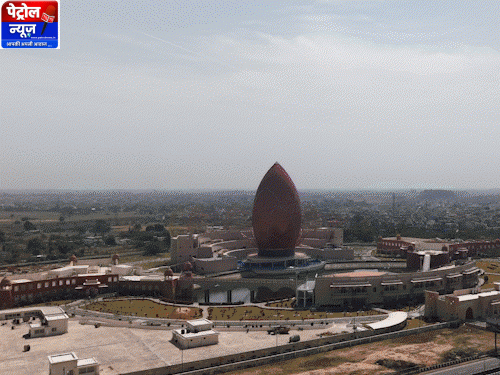
The museum campus in Ambala has been built on 22 acres, the museum has swords and pictures of revolution heroes.
The largest museum of the 1857 revolution in Ambala has been completed. It mentions the 1857 revolution that started from Ambala through laser shows and graphics. This entire museum has been prepared according to Gen-Z generation. Its cost is approximately 600 crore rupees.
For the first time in the country, the revolution for independence started from Ambala itself. This was revealed through a telegram issued in 2012. Historian KC Yadav’s book ‘Revolt of 1857 in Haryana’ also mentions this. However, some historians still consider the beginning of the 1857 revolution to be from Meerut.
To bring forward the beginning of this revolution that started from Ambala, the Haryana government decided to build a museum. Museum Director Kuldeep Saini informed that preparations are underway to open it to the public in 2026.
80% of this entire campus spread over approximately 22 acres has been prepared based on digital technology. The 22 galleries built in it will refresh tourists’ memories of the 1857 revolution through virtual reality.
Here in the evening there will be a water show, in which pictures will reflect from water fountains and hit the 65-meter high memorial tower. The graphics will create a feeling as if a horse emerging from the 1857 revolution is jumping and reaching directly to the memorial tower.
Read the complete report about this museum…

During the water show, pictures of the heroes of the 1857 revolution will be displayed on the 65-meter high memorial tower.
Campus spread over 22 acres, read what the structure will be like…
- 65-meter high memorial tower built: Upon entering the campus, the first thing that catches the eye is the 65-meter high memorial tower. A high-speed lift will take visitors to its 13th floor, where an immersive projection show (feeling of the show running all around) will be displayed. Right in front of it, an open-air theater with a capacity of about 2000 spectators has been built.
- The entire history will appear like a film: As evening falls, the story of 1857 will be shown here under the open sky through water, light and sound. Watching the projection on water screens, projection mapping on museum walls and light and sound show on the memorial tower will make it feel like the entire history is playing out like a film. One of the projectors used in this show costs approximately 5 crore rupees.

Short movie of 1857 revolutionaries playing on the wall
- 3-storey museum and 22 high-tech galleries: The main museum located in the center of this entire campus is divided into three floors. Inside it, 22 galleries have been created, which present history in a chronological manner. The 360 immersive projection created in the ‘Wars in India’ gallery gives viewers the feeling of 1857.
- The ‘Silent Tree’ of local artisans’ art and martyrdom: All the art and craft work done inside the museum has been carried out by artisans from Haryana. This includes the use of terracotta (clay work), jute artistry, and traditional phulkari. A ‘Silent Tree’ has been created in the ‘Sacrifice’ gallery, depicting the hangings on trees that took place during British rule.

In the museum, pages of digital books can be turned with hand gestures through graphics.
The museum will tell how the revolution began from ‘Ambala’
The spark arose in Ambala 9 hours before Meerut
The museum’s biggest attraction is linked to the historical claim that the spark of the 1857 revolution had already ignited in Ambala before Meerut. A gallery named ‘Towards Ambala’ showcases the strategic importance of Ambala Cantonment.
Adjacent to it is a gallery called ‘Events of Ambala’. It explains that even before the formal beginning of the revolution, discontent and rebellious activities against British rule had already intensified in Ambala. Then comes the section where the historic telegram found in 2012 is displayed.
According to the telegram, on the morning of May 10, a conflict involving the 60th and 5th Native Infantry began in Ambala, whereas the rebellion in Meerut occurred that same evening. This means the events in Ambala took place approximately 9 hours before Meerut.

Silent tree in a gallery of the museum.
Secret Planning Made with Bread and Lotus Flowers
This revolution did not happen suddenly, but a complete plan was made behind it. The ‘Planning of Revolution’ gallery made from reed art explains that the revolutionaries had planned to use even the intense heat of North India as a weapon against the British. Tree bark was used to deliver messages, bread to connect villages, and lotus flowers were used as secret signals to convey messages to soldiers in the cantonments.

The museum campus spread over 22 acres.
Greased Cartridges and Weapons of Freedom
In the ‘Causes of Revolution’ gallery built in the museum, the incident of greased cartridges has been depicted through metal artwork and holographic shows. Meanwhile, the ‘Tools of Freedom’ gallery explains that swords and guns were not the only weapons in the freedom struggle. Music, literature, poetry and mass movements also played a major role in uniting people and strengthening the freedom struggle.

Museum Director Dr. Kuldeep Saini giving information.
Now read, key excerpts from the conversation with the Museum Director…
Question: When will the museum open for tourists? Director: The artwork will be finished soon, it is in the final stage. There are hopes to start the museum this year itself.
Question: Will tickets need to be purchased for entry here? Director: Yes, the ticket price is yet to be decided. A society has been formed to run it. This society will be formed under the chairmanship of the CM.
Question: What is the total cost of this project? Director: The project has been completed at a cost of approximately 600 crore rupees. This will promote tourism across Haryana, it is being made into an international level monument, which will attract tourists from outside as well.
Question: Did any challenges come up in this entire project? Director: There were many challenges in this project. Earlier, flex or statues used to be installed in museums, this is not that kind of museum. Attracting Gen Z was also a challenge in this. Keeping them in mind, virtual reality was added to it.