
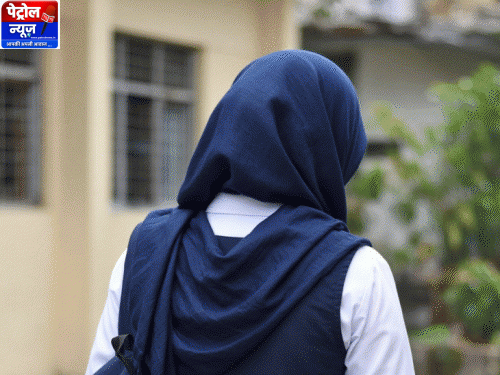


The Allahabad High Court has refused to grant permission to wear a hijab in schools. The court stated on Monday that it is mandatory to follow the school uniform rules. Wearing a uniform fosters a sense of equality among children.
It establishes a school’s identity and maintains an environment free from religious discrimination. Therefore, no student can insist on changing the school’s prescribed dress code.
The court stated-

Permission to wear a hijab on an individual basis cannot be granted. This would be against the very concept of a uniform. It would shift the authority to determine school discipline from the institution to individual students.
A division bench of Justice JJ Munir and Justice Inderjeet Singh made these remarks while dismissing the petition of a minor student, Sukaina Rizvi, who had sought permission to attend classes wearing a hijab along with the school’s prescribed dress code.
Now know the whole matter in a sequential manner-
- Sukaina Rizvi is an 11th-grade student at Tagore Public School in Attarsuiya, Prayagraj. She filed a petition in the High Court through her mother. The student argued that she had been attending school wearing a hijab from classes 6 to 10, and no objections were ever raised. The student also attached her old identity card and a group photo from the school with the petition.
- The student stated that she now wants to attend school in the 11th grade wearing a hijab, but is not being granted permission. We also complained to the DM, upon which the District Inspector of Schools (DIOS) sought a report. The school principal clarified that this is an educational institution where there is a uniform dress code for all students. Granting a special exemption to one student would disrupt the school’s system.
- The petitioner argued that wearing a hijab is linked to her religious belief. Wearing it grants her fundamental rights such as privacy, personal liberty, and freedom of speech. In such a situation, the school should be directed not to stop her from wearing a hijab.
Court said: Only school administration has the complete right to decide dress code
The court stated-as long as the school’s dress code is uniform for all children, is framed with the right intent, and does not discriminate against anyone, the school administration has the absolute right to decide what the dress will be.
Even if the school had previously allowed the wearing of a scarf (hijab), it does not mean that this has become a permanent right for the students forever. The school administration is free to change its rules. It is not compelled to continue with old exemptions.
Court stated: Wearing hijab is not an essential part of the Islamic religion
The court stated: Wherever this issue has been raised, the High Court’s opinion has been consistent that wearing a headscarf (hijab) for women is not an essential part of the Islamic religion.
It is not as if the religion would be in danger without it, or that a woman would be excluded from the religion if she does not wear it. No facts or evidence have been presented to prove this either.
Court said – No ban on faith, expecting compliance with rules
In its verdict, the Allahabad High Court referred to an old judgment of the Kerala, Bombay, and Karnataka High Courts.
In the case of ‘Fatima Tasneem vs State of Kerala’, the court had stated that while on one hand, a student has the right to wear clothes of their choice, on the other hand, a school or institution has the right to enforce its own rules and regulations.
When there is a conflict or dispute between these two rights, the larger interest and discipline of the institution will be given more importance than individual preference.
In the ‘Aishat Shifa vs. State of Karnataka’ case in the Supreme Court, the two judges had a split verdict, so there is no final decision on this issue yet.
The court stated that the school is not imposing any restrictions on the student’s faith, but is merely expecting adherence to institutional discipline and uniforms. Following this, the court dismissed the petition.