

Rajesh Sharma | Bhopal20 minutes ago

The Datia Assembly by-election result is not merely a verdict on one seat, but it has also emerged as an indicator of the strategies, organisational strength and future political direction of both the BJP and Congress in Madhya Pradesh.
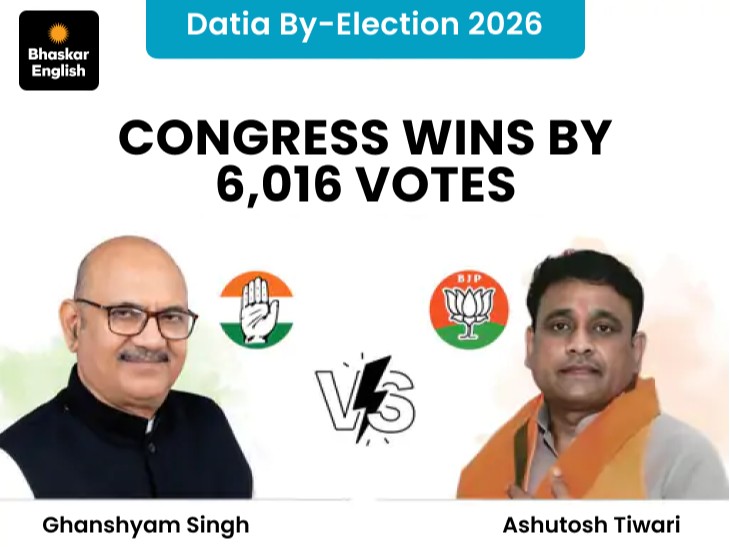
Despite the BJP deploying the full strength of the Chief Minister, ministers, MLAs and its organisational machinery, party candidate Ashutosh Tiwari lost to Congress’s Ghanshyam Singh by 6,016 votes.
The Congress had also defeated Dr Narottam Mishra from the same seat in the 2023 Assembly election, by 7,742 votes.
Following the defeat, Ashutosh Tiwari said the party would review the results, while Ghanshyam Singh described the victory as the “blessings of the people”. With the win, the Congress has retained its strength of 65 seats in the Madhya Pradesh Assembly.
Several political and organisational factors are being cited for the BJP’s defeat. Read the report…

Five key reasons behind BJP’s defeat
1. Decision to change candidate backfired
After the Datia seat fell vacant, Dr Narottam Mishra had begun preparing for the by-election, and his supporters expected him to be the BJP candidate.
However, the party replaced the expected choice at the last moment and fielded Ashutosh Tiwari.
Opposing the change, Narottam Mishra’s supporters blocked the Gwalior-Jhansi Highway for nearly 18 hours. The protest ended after Mishra appealed to his supporters, but political observers believe resentment among some workers continued until polling day.
The state leadership had reportedly sent Mishra’s name to the central leadership, suggesting that the final decision to change the candidate was taken at the central level.
Political analysts believe that if a change was inevitable, the party could have taken Mishra into confidence and assigned him a significant responsibility. The failure to do so may have affected the morale of the organisation and local workers.
2. BJP fails to manage caste equations
The BJP placed considerable emphasis on caste equations during the campaign.
Datia has around 40,000 Kushwaha and 20,000 Yadav voters. Chief Minister Mohan Yadav campaigned to reach out to the Yadav community, while BJP MP Bharat Singh Kushwaha was given responsibility for mobilising Kushwaha voters.
Kushwaha community meetings were organised during the campaign, and the Chief Minister also visited the Lav-Kush temple.
The party expected strong support from both communities. However, according to political observers, a section of these voters did not fully align with the BJP after the candidate change.
The results suggest that the BJP could not secure the level of support it had anticipated.

Chief Minister Dr. Mohan Yadav offering prayers at the Luv-Kush Temple in Datia.
3. Inactivity of Narottam supporters felt at booth level
For nearly 18 years, Dr Narottam Mishra had been the BJP’s prominent organisational and political face in Datia. His supporters also held influence across several organisational positions.
After he was denied the ticket, a large number of his supporters were reportedly not actively visible in the campaign. According to political observers, some maintained their distance from the election campaign while remaining within the party.
Given the limited time available, the BJP could not fully reactivate the local network that had been built around Mishra.
The party brought workers from neighbouring districts and Assembly constituencies to fill the gap. However, a lack of familiarity with Datia’s local geography and social dynamics reportedly became apparent.
At one point, some workers even reached villages in the Bhander Assembly constituency instead of Datia to campaign.
4. Deployment of MLAs and ministers fails to deliver
The BJP treated the by-election as a prestige battle and deployed its entire organisational machinery.
The 291 polling booths were divided into 20 Shakti Kendras, with each centre assigned to an MLA. Eight ministers also made repeated visits to the constituency.
However, the election result suggests that the strategy failed to influence voters sufficiently.
Neither the MLAs could create the expected momentum at the booth level nor did the presence of ministers significantly alter the electoral equations.
5. Discontent from 2023 remained
Political observers believe that voter dissatisfaction following the 2023 Assembly election had not completely disappeared by the time of the by-election.
The BJP made development in Datia a major campaign issue, but voters reportedly remained unconvinced by the government’s claims on local issues such as roads, water, employment and business.
Although the party turned the election into a prestige battle, it could not completely address the local discontent.
Voter turnout was also around 9 percentage points lower than in the 2023 Assembly election, which may have influenced the outcome.
What next for the BJP?
The impact of the Datia by-election is unlikely to remain limited to one Assembly seat. The result could have implications for the BJP’s organisation, leadership and strategy for the 2028 Assembly election.
1. Review of candidate selection and organisation
The party is likely to review its candidate selection, booth management and internal factionalism.
Questions may also be raised about why the organisation failed to contain the resentment that emerged after the candidate was changed.
2. Congress gets fresh political ammunition
The BJP is in power in Madhya Pradesh, while Datia had long been considered one of its strongholds.
Losing the seat gives the Congress an opportunity to intensify its attacks on the government and the BJP organisation. The Opposition is likely to portray the result as evidence of anti-incumbency and a strategic failure by the ruling party.
3. Differences over candidate change could surface
Different views may emerge within the BJP over the reasons for the defeat.
One section could blame the candidate change, while another could argue that if Narottam Mishra’s local influence remained as strong as claimed, the new candidate should also have benefited from that organisational network.
4. 2028 ticket strategy could change
Political analysts believe the Datia result could influence the BJP’s ticket strategy for the 2028 Assembly election.
The party may become more cautious about denying tickets to leaders who have repeatedly won their constituencies.
Around 50 Assembly seats in Madhya Pradesh have legislators who have won four to nine consecutive elections. In this context, the Datia result could become an important political signal for future ticket distribution.
Five key reasons behind Congress victory
1. Familiar face wins voters’ trust
The Congress had several options for the by-election, including Ghanshyam Singh, Awadhesh Nayak and a member of former MLA Rajendra Bharti’s family.
According to the party, an internal survey identified Ghanshyam Singh as the strongest candidate.
His association with the Datia royal family and his experience as a two-time MLA gave him strong local recognition and personal outreach, which benefited the Congress.
2. Unity outweighs internal factionalism
The Congress, often associated with internal factionalism, appeared relatively united during the by-election.
Despite reports of differences during the Rajya Sabha election, state Congress president Jitu Patwari and Digvijaya Singh campaigned together.
Their joint presence sent a message of unity to party workers.

During the Datia election campaign, Digvijaya Singh and Jitu Patwari were seen together.
3. Internal discontent was contained
There was reportedly some resentment among supporters of Awadhesh Nayak and Rajendra Bharti after Ghanshyam Singh was given the ticket.
Nayak was denied a ticket for the second consecutive time, while Ghanshyam Singh shifted to Datia from Sewda.
Rajendra Bharti stayed away from campaigning due to health reasons, while there were reports that some of his supporters were in contact with the BJP.
The Congress leadership attempted to contain the discontent. During the campaign, state president Jitu Patwari visited Rajendra Bharti’s residence several times.
The move appeared to help keep the campaign united.
4. Campaign reached the booth level
Instead of relying solely on rallies by senior leaders, the Congress divided the constituency into four zones and assigned separate leaders to each.
Jitu Patwari repeatedly campaigned in villages and launched sharp attacks against the BJP. He also appealed to voters not to be influenced by pressure or inducements.
The party maintained an active grassroots campaign and kept its organisation engaged up to the booth level.
5. Congress benefits from caste equations
The Congress focused particularly on Brahmin, Kushwaha, Yadav and SC/ST voters.
To strengthen outreach among Kushwaha voters, the party appointed Siddharth Kushwaha as election in-charge.
The Congress believes that the presence of Azad Samaj Party candidate Damodar Yadav resulted in greater division of SC votes, causing relatively more damage to the BJP.
The changed caste equations ultimately benefited the Congress.

What next for the Congress?
The Datia victory is being viewed by the Congress as more than an addition of one Assembly seat. It could provide the party with a psychological advantage in Madhya Pradesh politics.
1. Jitu Patwari’s leadership could strengthen
For a Congress facing repeated electoral challenges, winning a high-profile seat such as Datia is a significant achievement.
The victory could become one of Jitu Patwari’s major electoral successes since becoming state Congress president and strengthen his position within the organisation.
2. Congress will project victory as a political message
The Congress is likely to showcase the result as an example of defeating the BJP in one of its traditionally strong areas.
The victory could boost the morale of party workers and increase confidence in the strategy adopted for future elections.
3. Anti-incumbency narrative likely to intensify
The Congress is expected to present the victory as an indication of growing public support against the government.
The party will seek to send a broader message that the BJP’s political dominance can be challenged, the Congress is returning to the electoral contest and an anti-incumbency mood is emerging in Madhya Pradesh.