

Vijay Singh Baghel. Bhopal17 minutes ago

Poor patients in remote and tribal areas of Madhya Pradesh may soon have better access to specialist doctors at government hospitals, with the state introducing an incentive-based approach to address the shortage of medical professionals in rural areas.
Under the National Health Mission (NHM)-linked ‘You Quote, We Pay’ policy, specialist doctors willing to serve in remote areas can negotiate their remuneration with the government. The aim is to attract experienced doctors to rural and tribal hospitals by offering competitive pay and additional career incentives.
The government is also considering benefits for young doctors who serve in difficult and remote areas, including preference and bonus marks for postgraduate (PG) admissions.
Specialists to be offered negotiated salaries
Doctors, particularly specialists, often hesitate to work in rural and tribal areas because of limited facilities, difficult living conditions and lower earnings compared with private practice in cities.
Under the ‘You Quote, We Pay’ model, state authorities can directly negotiate with specialist doctors and determine their remuneration based on their salary expectations and mutual agreement.
The initiative is aimed at ensuring that specialists such as gynaecologists, paediatricians and surgeons are available at hospitals closer to rural communities.
Incentives for doctors serving in remote areas
Doctors posted in difficult and remote areas are being offered additional incentives, including a special hardship-area allowance and improved residential facilities.
Those who serve in rural areas can also receive benefits during admission to higher medical education and PG courses, including preference and reservation-related incentives, as applicable under government rules.
Additional incentives for C-sections and maternal care
To improve maternal and child healthcare in rural areas, female gynaecologists, paediatricians and anaesthetists are being offered additional remuneration and incentives for performing Caesarean sections.
The objective is to ensure that pregnant women facing complications can receive timely treatment without having to be shifted to distant cities.
ANMs and Frontline health workers to receive bonuses
Auxiliary Nurse Midwives (ANMs) working at the grassroots level are also being provided special incentives for ensuring timely antenatal check-ups, vaccinations and online recording of patients’ health information.
Staff involved in providing healthcare services to adolescents are also eligible for incentive-based payments.
Multi-skilling training to address doctor shortage
To tackle the shortage of specialists, the government has also started multi-skilling programmes for general doctors.
Through this training, doctors can acquire skills to handle multiple services, including basic obstetric care, paediatric treatment and basic anaesthesia. The initiative is intended to ensure that essential medical services continue even when specialists are unavailable.
States Responsible for Healthcare, Centre Provides Support
The government has clarified that providing healthcare services is primarily the responsibility of state governments. However, the Centre provides financial assistance, budgets and programmes through the National Health Mission (NHM) to strengthen healthcare infrastructure and services.
What is the ‘you quote, we pay’ policy?
Under the model, doctors can state the remuneration they expect for serving in remote locations, and the government can negotiate and finalise the payment accordingly.
The policy is aimed at addressing a key reason why specialists often avoid government hospitals in villages, small towns and tribal areas. Fixed government salaries may not be attractive enough compared with earnings available through private practice in larger cities.
By negotiating salaries directly with specialists, the government hopes to make rural postings financially attractive while ensuring that patients receive specialist treatment closer to home.
14 new government medical colleges approved for Madhya Pradesh
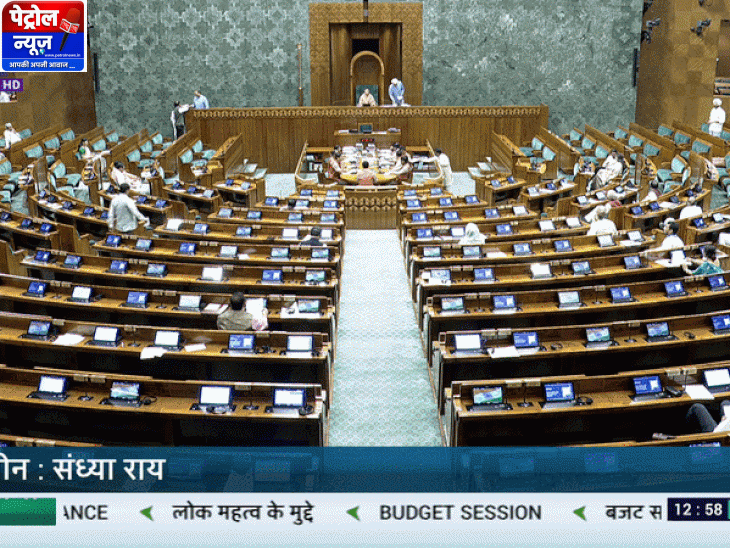
The issue of shortage of doctors and hospitals in tribal areas was raised in the Lok Sabha by Ratlam-Jhabua-Alirajpur MP Anita Nagar Singh Chouhan.
In a written response, Union Minister of State for Health Anupriya Patel said the Centre has approved a total of 14 new government medical colleges for Madhya Pradesh. Of these, six are being established in tribal-dominated districts.
Rural and Tribal patients expected to benefit
Residents of remote villages and tribal areas, particularly in the Ratlam-Jhabua-Alirajpur region, are expected to benefit from the expansion of medical infrastructure.
Upgrading district hospitals into medical colleges is expected to bring specialist doctors, modern medical equipment and improved treatment facilities closer to local communities. This could reduce the need for poor and tribal patients to travel to Indore, Ahmedabad or other major cities for treatment.
Priority for districts without medical colleges
Under the Centre’s scheme for establishing new medical colleges, priority is given to districts that do not already have a government or private medical college.
Backward and aspirational districts are given preference under the scheme to strengthen healthcare infrastructure in areas that have historically lacked adequate medical facilities.
Centre to fund 60%, state 40%
The Centre and state governments are sharing the cost of constructing the new medical colleges.
For states such as Madhya Pradesh, which fall under the general category, the Centre provides 60% of the funding, while the state contributes the remaining 40%. In northeastern states, the Centre can provide up to 90% of the funding.