


14 minutes agoAuthor: Akriti Saxena

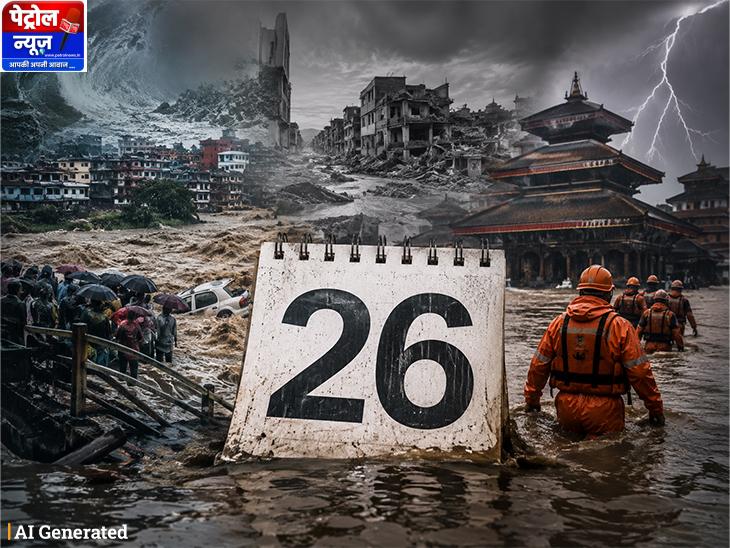
From the 2004 Indian Ocean tsunami and 2001 Gujarat earthquake to the 2008 Mumbai terror attacks and Chernobyl, several major tragedies occurred on the 26th. Nepal’s latest disaster has once again raised questions about whether the date has a sinister pattern.
The calendar date August 26, 2026, has now been added to a long and grim list of disasters associated with the number 26.
On August 26, a sudden surge of water, ice and debris entered the Bhote Koshi river system in Nepal’s Rasuwa district, triggering devastating flash floods. The disaster destroyed settlements, roads and bridges, damaged hydropower infrastructure and affected the Nepal-Tibet border.
The flooding followed a collapse of glacial rock and ice in the Himalayas, sending a huge volume of water and debris downstream. By August 31, authorities had reported more than 900 deaths and nearly 4,500 people missing.
The scale of the tragedy has revived an unusual question: Why do so many major disasters appear to have happened on the 26th?
August 26, 2026: Nepal’s flash floods

The Nepal floods are the newest addition to a series of catastrophes that occurred on the 26th of different months and years.
The disaster in Rasuwa was particularly destructive because of the sudden arrival of water and debris through the Bhote Koshi river system. Infrastructure along the river was badly damaged, including roads, bridges, hydropower facilities, and the Rasuwagadhi border crossing.
The event has also highlighted the vulnerability of Himalayan communities to sudden glacial and extreme-weather events.
But while the date is striking, the cause of the disaster has nothing to do with the calendar.
January 26, 2001: Gujarat earthquake

For India, one of the most prominent disasters associated with the 26th is the Gujarat earthquake of January 26, 2001.
A magnitude 7.7 earthquake struck the state on Republic Day, with Kutch among the worst-hit areas. Around 20,000 people were killed and more than 1.6 lakh injured.
Entire towns were devastated, thousands of buildings collapsed and the earthquake became one of the deadliest natural disasters in India’s modern history.
The fact that it occurred on Republic Day made the date even more memorable.
July 26, 2005: Mumbai floods

People walk through a waterlogged street following heavy rains in Mumbai, India (Representative Image)
Just four years later, another major Indian disaster struck on the 26th.
On July 26, 2005, exceptionally heavy rainfall brought Mumbai to a standstill. The city received around 944 mm of rain in 24 hours, overwhelming drainage systems and flooding roads, homes and railway lines.
According to PTI, 1,094 people died in Maharashtra.
The disaster became known as Mumbai’s 26/7 floods, turning the date itself into shorthand for one of the city’s worst weather disasters.
Indian Ocean tsunami of December 26, 2004

The aerial view of Marina beach after a tsunami triggered by an earthquake in the Indian Ocean hit the area in the southern Indian city of Madras December 26, 2004 (Image Source: Reuters)
Perhaps the strongest reason the number 26 stands out globally is the Indian Ocean tsunami of December 26, 2004.
A magnitude 9.1 earthquake struck off the coast of Sumatra, displacing huge volumes of seawater and generating tsunami waves across the Indian Ocean.
Indonesia, Sri Lanka, India, Thailand and several other countries were devastated.
Around 228,000 people were killed or left missing and presumed dead, making it one of the deadliest natural disasters ever recorded.
In India, more than 10,000 people died, with Tamil Nadu, Andhra Pradesh, Kerala and the Andaman and Nicobar Islands among the worst affected.
December 26, 2003: Bam earthquake

Devestation after the 2003 Bam earthquake (Image Source- IRNA)
Exactly a year before the tsunami, another deadly earthquake struck on December 26.
A magnitude 6.6 earthquake hit Bam in southeastern Iran, destroying much of the historic city. Thousands of buildings collapsed and around 31,000 people were killed.
The proximity of the Bam earthquake to the 2004 tsunami makes the appearance of December 26 particularly striking.
May 26, 2006: Yogyakarta earthquake

Ruins of homes destroyed by the May 2006 earthquake in south and central java. (Image Source: UN NEWS)
On May 26, 2006, a magnitude 6.3 earthquake struck near Yogyakarta on Indonesia’s Java island.
The shallow earthquake caused extensive destruction in densely populated areas. More than 5,700 people were killed, while tens of thousands were injured.
October 26, 2015: Hindu Kush earthquake
On October 26, 2015, a magnitude 7.5 earthquake struck the Hindu Kush region.
The earthquake affected Afghanistan, Pakistan and parts of northern India, killing around 400 people and causing widespread destruction.
The disaster added another major earthquake to the growing list of catastrophes associated with the 26th.
The pattern goes back decades
The association is not limited to disasters of the 21st century.
On July 26, 1963, a magnitude 6.1 earthquake struck Skopje, then part of Yugoslavia. About 1,070 people died, while more than 200,000 were left homeless.
On November 26, 1943, a magnitude 7.5 earthquake struck Turkey’s Ladik-Samsun-Havza region, killing around 4,020 people.
One of the deadliest earthquakes on the list occurred on December 26, 1939, when a magnitude 7.8 earthquake struck Turkey’s Erzincan region. About 32,700 people were killed.
Other major earthquakes associated with the date include the Lerissos earthquake in Greece on September 26, 1932, the North Izu earthquake in Japan on November 26, 1930, and the Gonghe earthquake in China on April 26, 1990.
It isn’t just earthquakes but man made disasters occuring on ‘26’
The apparent “26 factor” becomes even more striking because the list extends beyond natural disasters.
On November 26, 2008, the Mumbai terror attacks began. Ten Lashkar-e-Taiba terrorists launched coordinated attacks at several locations across the city, including Chhatrapati Shivaji Maharaj Terminus and the Taj Mahal Palace Hotel.
The siege lasted nearly three days, killing 166 people and injuring more than 300.
The date subsequently became synonymous with one of the darkest episodes in India’s recent history: 26/11.
On April 26, 1986, the Chernobyl nuclear disaster began when Reactor No. 4 exploded during a safety test at the nuclear power plant in then-Soviet Ukraine.
The accident released radioactive material across parts of Europe. The immediate official death toll was 31, while the long-term health impact has been the subject of extensive scientific assessment.
The list also includes the Lauda Air Flight 004 crash on May 26, 1991, which killed all 223 people aboard, and the Benxihu Colliery disaster in China on April 26, 1942, when a gas and coal dust explosion killed 1,549 miners.
More recently, the Kabul airport bombing on August 26, 2021, killed at least 183 people during the US-led evacuation from Afghanistan.
On September 26, 2023, a fire at a wedding hall in Qaraqosh, Iraq, killed more than 100 people after indoor pyrotechnics ignited flammable material.
So, is there really a ‘26 factor’?
Scientifically, no.
There is no evidence that the number 26, or any particular calendar date, makes earthquakes, floods, tsunamis or other disasters more likely.
Earthquakes occur because of movements and stresses within the Earth’s crust. Their timing is governed by geological processes, not the calendar.
Floods are influenced by rainfall, river conditions, terrain, drainage and weather systems. Tsunamis are generally triggered by events such as undersea earthquakes or volcanic activity.
Human-made disasters have entirely different causes, ranging from engineering failures and unsafe practices to deliberate acts of violence.
So the repeated appearance of the 26th does not demonstrate a causal connection.

Why does the pattern feel so unusual?
The answer lies partly in human pattern recognition.
There are 31 possible dates in a month, and over centuries thousands of disasters have occurred around the world. Some dates will inevitably accumulate several major events purely by chance.
Once particularly memorable tragedies such as 26/11, the Gujarat earthquake and the Boxing Day tsunami become associated with the number 26, people are more likely to notice and remember other disasters occurring on the same date.
This can make a coincidence appear more meaningful than it actually is.
In other words, the “26 factor” is a pattern in the historical record, not a scientific phenomenon.

A grim coincidence, not a curse
Nepal’s August 26 flash floods have added another devastating event to a date already associated with some of the world’s most destructive earthquakes, floods, tsunamis, terror attacks and industrial disasters.
The coincidence is undeniably striking.
But there is no scientific evidence that August 26, January 26, November 26 or any other 26th carries a higher risk of catastrophe.
The disasters share a date, not a cause.
The “26 factor” may therefore be a fascinating pattern in history, but it is not a force of nature, and the number 26 is not cursed.