

Ranchi14 minutes agoAuthor: Abhishek Prasad

Jharkhand is often described as the mineral heartland of India. Its coal, iron ore, uranium and other mineral reserves have made the state strategically important to the country’s industrial economy. Jamshedpur and Bokaro are names closely associated with India’s steel story, while its forests, waterfalls and hills add to its natural wealth and tourism potential.
But when Jharkhand was carved out of Bihar in 2000 after a prolonged movement for a separate state, the aspiration was not merely to create a new political boundary. The movement, led by several tribal and regional leaders, was also rooted in the hope that the state’s natural wealth would bring greater development and opportunities to its people.
More than two decades later, many young people say that promise remains incomplete. Despite its enormous natural resources, Jharkhand continues to face challenges around employment, higher education and uneven development. For thousands of young people, government recruitment has become one of the most important avenues for a stable career.
And it is here that years of frustration have now spilled onto the streets of Ranchi.

Students on hunger strike at the Jaipal Singh Munda Stadium in Ranchi | Photo by Yousuf Sarfaraz
JPSC protest: Years of preparation meet allegations of irregularities
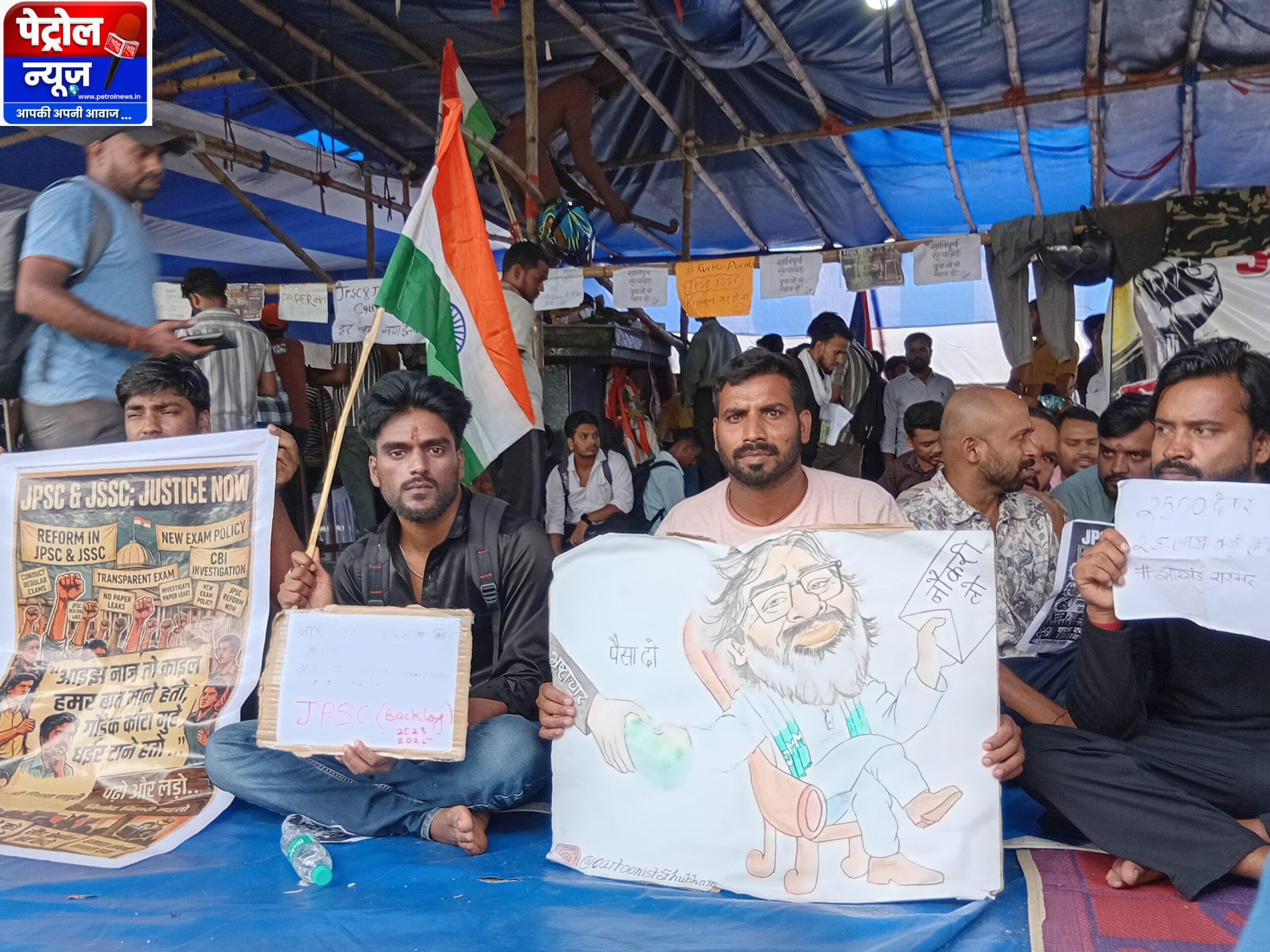
The ongoing student protest in Ranchi has been driven by anger over alleged irregularities in recruitment examinations conducted by the Jharkhand Public Service Commission (JPSC) and Jharkhand Staff Selection Commission (JSSC). Students have raised concerns over the recruitment process, including allegations surrounding examination procedures and question-paper related irregularities, and are demanding transparency, accountability and a system they can trust.
For Vijendra, a government job aspirant from Ramgarh, the problem goes beyond an individual examination. He believes administrative instability and repeated lapses in recruitment have steadily eroded students’ confidence in the system.

“The government in Jharkhand is not stable and the decisions taken by the government are not very helpful or favourable for students. Take the JPSC and JSSC examinations. The conducting bodies have loopholes. When they publish the notification for an exam, they have to issue it four or five times for the same examination,” Vijendra said.
He argues that the uncertainty does not end with the notification. According to him, controversies surrounding examinations have become a recurring concern for aspirants who spend years preparing for government jobs.
“And when the exams are conducted, there are paper leaks or scams. In the last six-seven years, I have not seen a single examination that was conducted carefully. Almost every JPSC and JSSC exam has had some scam or paper leak,” he said.

Protesting against the irregularities in the JPSC and JSSC recruitment exam | Photo by Yousuf Sarfaraz
The frustration is particularly visible among students who have travelled to Ranchi from different parts of the state. They say that after investing years in preparation, they now want assurances that recruitment will be conducted fairly and that those responsible for established irregularities will be held accountable.
The protesters’ central demand is simple: examinations should be conducted transparently, recruitment should follow a clear timeline and candidates should be confident that merit not influence or malpractice will determine the outcome.

When ‘Gaon Chhodab Nahi’ echoes through a student protest
The protest also acquired a powerful Jharkhand identity when Padma Shri awardee and folk singer Madhu Mansuri Hasmukh arrived to support the students.
He sang “Gaon Chhodab Nahi”, a song deeply associated with Jharkhand’s cultural and social movements. As students joined in, the familiar voice of an earlier generation’s struggle echoed through a protest led by today’s youth.
The moment offered an unlikely bridge between two generations. The movement that once demanded recognition and a separate Jharkhand was rooted in questions of identity, rights and control over the state’s resources. Today’s students are raising a different question: what has that statehood delivered for their generation?
For the students gathered in Ranchi, the answer cannot be measured only in coal production, steel plants or mineral wealth. They want to see that economic importance reflected in education, employment and opportunities for young people.

A resource-rich state, but a generation waiting
Jharkhand’s contribution to India’s economy is difficult to overlook. Its coal fuels power and industry; its iron ore supports steel production; and its mineral wealth has helped make the state an important part of India’s industrial map.
Yet many students say there is a striking contrast between the importance of Jharkhand’s resources and the opportunities available to its youth.
Limited employment opportunities and competition for government jobs have made recruitment examinations particularly important for aspirants. When those examinations are delayed or become embroiled in allegations of irregularities, students say the consequences go far beyond one cancelled or disputed examination.

An aerial view captures the industrial layout of the Bihar Sponge Iron plant in Chandil. The facility relies heavily on coal combustion for direct reduced iron (DRI) production | Photo by Yousuf Sarfaraz
For some, it means another year of preparation. For others, another year without income, another attempt after an already long wait, and another postponement of plans.
That is why protesters describe their struggle as a fight for more than jobs. It is a fight to restore confidence in a system they believe should give every candidate an equal chance.
From Ranchi, a demand to be heard
Student protests in Jharkhand are not new. But this phase has drawn wider attention, with sustained demonstrations and hunger strikes by some student leaders adding momentum to the movement.
The protesters now want the issue to be viewed beyond the boundaries of Ranchi. Their argument is that a state that contributes significantly to India’s industrial growth should also be able to provide its young population with a recruitment system that is transparent, predictable and trustworthy.
Whether the current movement results in lasting reforms remains to be seen. But the scenes from Ranchi reflect a deeper frustration among a generation that says it has already waited long enough.
Behind the placards are students who have spent years preparing, families that have supported those preparations and young people who want an opportunity to build their futures in the state they call home.
Jharkhand may continue to power India’s industries with what lies beneath its soil. Its youth are now asking whether the state can also create enough opportunities for what lies above it their aspirations.