

Kolkata8 minutes agoAuthor: Tirthankar Das

Graphics by Gaurav Raj.
Long before water flowed through household taps, Indian cities depended on people who carried it.
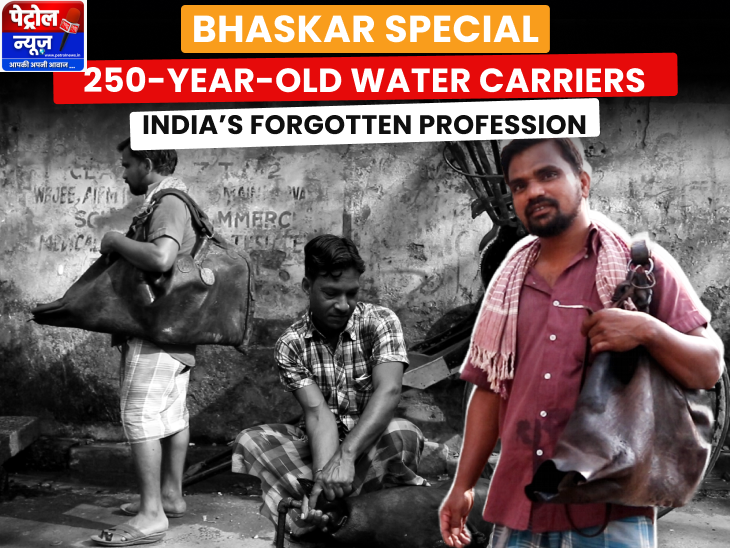
The Bhisti, or Vistiwala, was a traditional water carrier who transported water in a large leather bag known as a Moshok or Mashq. For centuries, these men supplied homes, shops, markets, and establishments, and were also employed around military camps and battlefields.
Today, the profession survives only in a few pockets of India. Kolkata is among the rare cities where Vistiwalas can still be seen walking through old neighbourhoods with their heavy leather bags slung over their shoulders. Their presence offers a glimpse of an India where water had to be physically transported before modern pipelines transformed everyday life.

The Moshok, once an everyday tool, now represents a disappearing chapter of urban history.
From Persia to India
The word Bhisti is generally traced to the Persian Behest, meaning paradise. Over time, the term became associated with traditional water carriers whose work was indispensable in communities where access to water was limited.
Bhistis carried water from wells, rivers, and other sources to wherever it was required. Their work became particularly important in crowded settlements and military camps. The profession was not simply a means of earning a living. Before modern water infrastructure, water carriers were an essential part of urban life.

British-era Vistiwalas carried heavy leather Moshoks through Kolkata’s streets, serving homes, markets and colonial establishments.
The Bhisti who saved Humayun
One of the most famous stories associated with the profession dates back to the Battle of Chausa in present-day Bihar in 1539, fought between Mughal emperor Humayun and Afghan ruler Sher Shah Suri.
According to the popular historical account, Humayun was defeated and fled towards the Ganga. After entering the river, he struggled against the current and was in danger of drowning. A Bhistiwala came to his rescue. He is said to have inflated his Moshok and helped the Mughal emperor stay afloat.
In gratitude, Humayun reportedly promised to grant the water carrier whatever he wished after regaining his lost empire.
Whether every detail of the account can be independently established or not, the story has endured as a powerful reminder of the role ordinary workers could play in extraordinary moments of history.

During the British era, human water carriers were a familiar sight across Kolkata, transporting water before modern pipelines transformed the city.
From history To literature
The Vistiwala also became part of India’s cultural memory.
In Bengal, the figure appeared in literature, reflecting how familiar the profession once was. Rabindranath Tagore mentioned the Bhisti in Juta Abishkar, while Sukumar Ray referred to the figure in his celebrated Abol Tabol. These references show that the Vistiwala was once a recognisable part of Bengal’s social landscape rather than an obscure occupation.

Vistiwalas once carried life’s most essential resource across India’s bustling cities.
The Moshok: The tool of the trade
At the centre of the profession is the Moshok, a traditional leather water bag capable of carrying around 20 to 30 litres of water. Carrying such a load repeatedly through crowded streets makes the profession physically demanding.
In Kolkata, Moshoks were traditionally manufactured around the No. 4 Bridge area of present-day Park Circus. They cost around ₹2,500 to ₹3,000 apiece and generally lasted around nine months, depending on usage and maintenance.
For generations, the Moshok was the Vistiwala’s most important tool.

Kolkata’s last vistiwalas
Today, around 30 Vistiwalas are believed to operate in a handful of pockets of Kolkata. Many of them are from Katihar in Bihar, where the occupation has continued through generations.
They can still be found in parts of Central Kolkata, including Bow Barracks, Eliot Road, Bowbazar, Ripon Street, Marquis Street, Vrindaban Das Lane, Rafi Ahmed Kidwai Road, and Sandal Road.Their customers are mainly buildings, shops, and establishments where fixed water connections are unavailable, inadequate, or unreliable. But their role has changed dramatically.
Once an essential part of Kolkata’s water supply, Vistiwalas are now usually called upon only when modern infrastructure cannot meet a particular need.

Today, every Vistiwala walking through Kolkata’s streets carries more than water, they carry a piece of history.
How modern infrastructure replaced them
The decline of the Vistiwala followed the expansion of modern water infrastructure. Municipal pipelines brought water closer to homes and businesses. Electric pumps made it easier to move water, while overhead tanks and modern plumbing reduced the need for manual transportation.
As Kolkata modernised, the Vistiwala gradually disappeared from the city’s everyday landscape. The occupation that once supported large numbers of workers became increasingly difficult to sustain. For those who remain, the profession is less about preserving heritage and more about earning a livelihood.

A profession slowly disappearing
The work has always been physically demanding, while incomes have traditionally been modest.
As demand has declined, the profession has become even harder to sustain. Younger generations have little incentive to inherit an occupation that is physically exhausting, financially uncertain, and increasingly unnecessary.

Kolkata’s last Vistiwalas keep alive a profession dating back centuries.
That is why the Vistiwala is disappearing quietly. There is no final ceremony, no official announcement, and no closing gate marking the end. The profession is simply fading as its practitioners grow older and their children choose other occupations.

As pipelines and pumps transformed Kolkata, the traditional Vistiwala profession slowly faded away.
More than a forgotten occupation
The remaining Vistiwalas are living links to India’s urban past. Their story connects Persian influence, Mughal-era history, Bengal’s literary tradition, the development of Indian cities and the arrival of modern municipal infrastructure.
India often remembers its rulers, monuments, and major events. But cities were also sustained by countless workers whose labour rarely entered official histories. The Vistiwala was one of them.

From wells and rivers to homes and markets, Vistiwalas kept cities supplied with water.
When Kolkata eventually has no one left carrying a Moshok through its streets, the city will lose more than an old profession. It will lose a living connection to a time when water did not arrive at the turn of a tap; it had to be carried, often on someone’s shoulders. The Vistiwala’s Moshok once carried water. Today, it carries a disappearing piece of India’s history.