

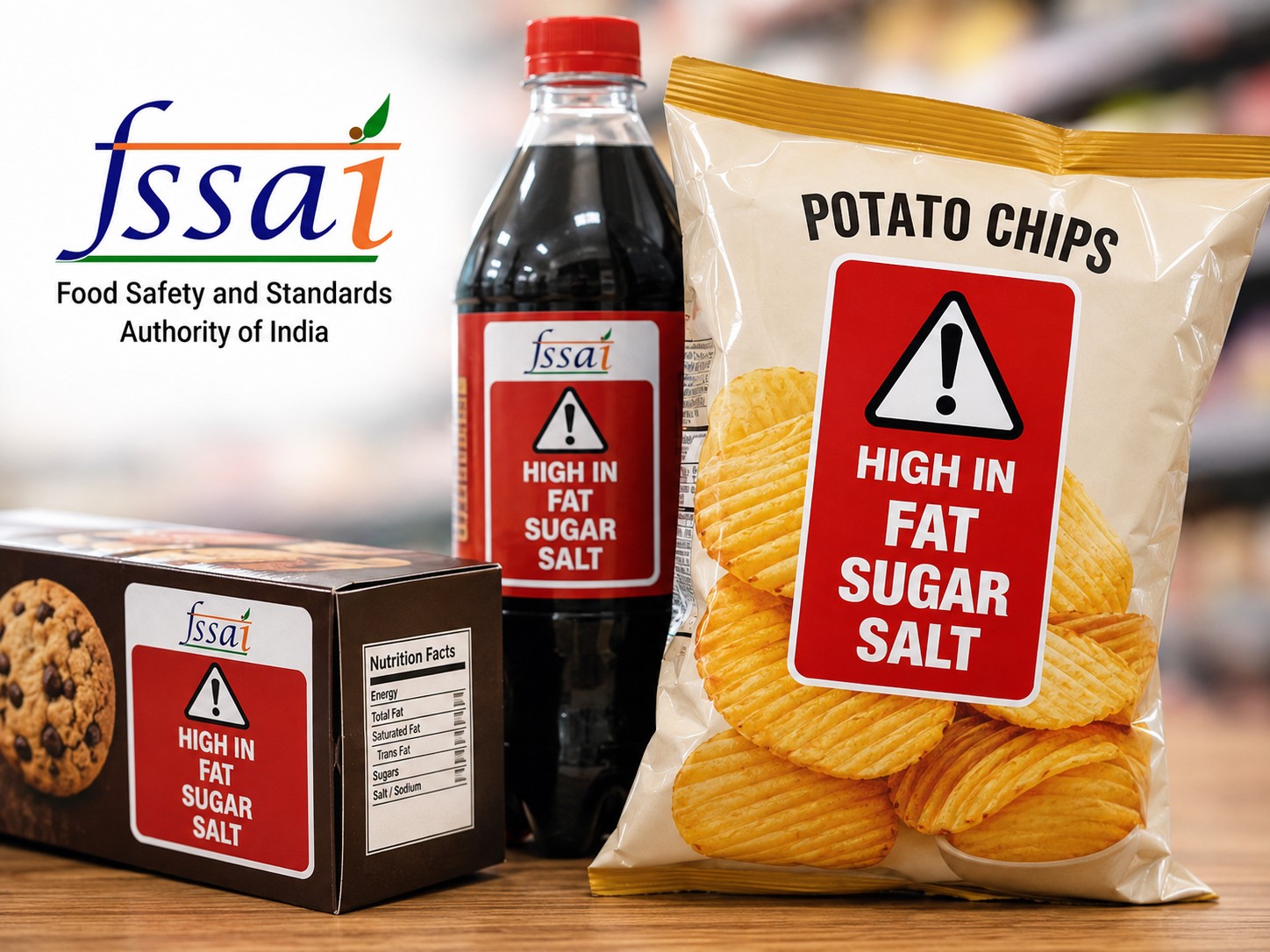


The Food Safety and Standards Authority of India (FSSAI) has informed the Supreme Court that it is planning to introduce prominent front-of-pack warning labels for packaged food products containing high levels of added saturated fat, sugar and salt.
Under the proposal, products exceeding specified nutritional thresholds would carry a red-coloured hexagonal warning symbol on the front of the package, making it easier for consumers to identify unhealthy food choices at a glance.
The proposal has been placed before the apex court through a compliance affidavit filed in response to ongoing proceedings concerning food labelling and consumer awareness.
Aims to help consumers make informed choices
According to the regulator, the proposed system is designed to provide consumers with a simple and easily understandable warning regarding products that contain excessive levels of nutrients linked to health risks.
The warning labels would carry declarations such as “High Fat”, “High Sugar”, “High Salt” or “Highly Sweetened Beverage”, depending on the nutritional profile of the product.
FSSAI said the labels would apply to food items found to contain high levels of at least two of the identified nutrients of concern, based on standards laid down in the Dietary Guidelines for Indians 2024, prepared by the Indian Council of Medical Research-National Institute of Nutrition (ICMR-NIN).
Supreme Court’s intervention
The affidavit was submitted following an August 13 order of the Supreme Court while hearing a petition filed by public charitable trust 3S and Our Health Society.
The petition seeks mandatory implementation of front-of-package warning labels on packaged food products across the country.
During the hearing, a bench comprising Justices J B Pardiwala and K Vinod Chandran expressed concern over delays in introducing such warnings and questioned whether the authorities were doing enough to protect public health.
Information to be displayed on the front of the pack
FSSAI told the court that the proposed system would place information relating to added fat, added sugar and salt prominently on the front of food packaging.
The warning symbol would appear in a font size larger than that used in the nutrition information panel typically found on the back of packets.
Officials believe that placing nutritional warnings on the front of packaging will make the information more visible and help consumers make quicker and better-informed purchasing decisions.
Products exempted from the proposal
Not all food products would fall within the scope of the proposed warning system.
FSSAI has suggested exempting certain categories, including:
- Single-ingredient food products
- Foods naturally high in fat, sugar or salt
- Ghee
- Edible oils
- Salt
- Sugar
- Jaggery
- Honey
These products would continue to be governed by existing food safety and labelling regulations.
Phased rollout planned
The regulator has proposed implementing the front-of-pack nutrition labelling system in stages to allow both consumers and the food industry time to adapt.
Phase I
The first phase would apply to:
- Products high in two or more nutrients of concern
- Certain sweetened beverages
Phase II
The second phase would expand coverage to products that are high in any one of the specified nutrients.
FSSAI said the staggered approach would give manufacturers sufficient time to reformulate products if required and would also help improve consumer acceptance of the new labelling system.
Focus on public health
The regulator emphasised that the proposal is intended to support healthier dietary choices, particularly among children and other vulnerable sections of the population.
Under the proposed framework, a food product would be classified as high in fat, sugar and salt (HFSS) if it exceeds the nutrient thresholds prescribed in the ICMR-NIN dietary guidelines.
Such products would be required to display the warning prominently within a red hexagon on the front of the pack.
FSSAI added that the proposal will now undergo the prescribed regulatory process and, if approved, will be formally introduced through amendments to existing food safety and labelling regulations.