


5 hours agoAuthor: Swadhin Patel

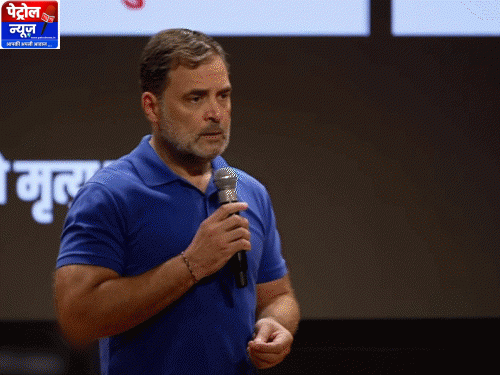
Rahul Gandhi recently wore a blue T-shirt while speaking about casteism. The choice was significant because blue has long been associated with BR Ambedkar, Dalit identity and the fight against caste discrimination.
More recently, Gandhi has also used other colours to match his political messaging.
During his “Chhatron Ki Goonj” outreach programme with Gen Z students, he appeared in yellow and pink shirts. At the Pune event, he wore yellow while meeting women students and paired it with a “Girl Power” badge. He wore pink at Prayagraj and other youth interactions.

From Mahatma Gandhi’s white khadi to BR Ambedkar’s blue suit, political clothing has evolved into a powerful form of non-verbal communication.
So, how much does colour really matter in Indian politics, and how do these colours convey messages? Let us understand.
How much does colour matter in politics?
India is a visually driven and diverse democracy, where clothing and colour can work as a form of instant, non-verbal communication.
They can convey ideology, identity, accessibility, regional connection, simplicity or authority without a leader saying much.
Party flags, campaign material and leaders’ clothes create instant recognition and emotional associations.

Political leaders rarely choose their clothes completely at random. A consistent look creates a political brand, while a sudden change can send a specific message.
Colour can make a leader appear more approachable, show solidarity with a community, claim cultural identity or differentiate them from political rivals.
It is not everything. Policies, organisation and performance matter much more. But colour can strengthen a political message, influence media coverage and help leaders connect with different groups of voters.
Key historical examples
Mahatma Gandhi: White khadi
Mahatma Gandhi turned clothing into a political tool. He moved from Western suits to simple white khadi and eventually the loincloth to identify himself with India’s poor.
Khadi also became a symbol of swadeshi, self-reliance and opposition to British rule. White khadi came to represent simplicity, nationalism and moral authority and influenced generations of Indian politicians.

The Khadi movement was launched by Mahatma Gandhi from the Sabarmati Ashram in May 1915. Image courtesy: amritmahotsav
BR Ambedkar: The blue suit
BR Ambedkar took a very different approach. Coming from a Dalit background, he often appeared in carefully tailored Western suits, including blue.
His clothing represented education, modernity, dignity and equality. It challenged the caste-based restrictions and social discrimination faced by Dalits.
Blue later became an important colour of Dalit and Ambedkarite politics. Statues of Ambedkar are also commonly shown with him wearing a blue coat and holding the Constitution.

BR Ambedkar
The contrast between Gandhi’s simple, rural-inspired clothing and Ambedkar’s formal Western suits also reflected their different approaches to social and political change.
Contemporary leaders and their colours
Rahul Gandhi: White represents simplicity and accessibility.
Blue has increasingly been used when he speaks about Ambedkar, caste discrimination, reservation and social justice.
Yellow and pink have been used during youth and women-focused outreach to project energy and approachability.

Arvind Kejriwal: His famous “muffler man” image, simple shirts, sweaters, muffler and casual footwear, helped create the image of the “aam aadmi”.
It projected middle-class simplicity and an anti-elite image.

Narendra Modi: His clothing is highly planned. As Gujarat Chief Minister, he was known for brighter colours.
As Prime Minister, he has often favoured pastels, white and saffron, along with the short-sleeved “Modi kurta” and jackets.
He also regularly wears regional turbans, scarves and traditional fabrics during visits to different states.
These choices signal cultural connection and national integration. Saffron remains a strong visual association with the BJP and Hindutva.

Akhilesh Yadav: Red is closely associated with the Samajwadi Party.
His red cap and red scarves reflect the party’s socialist identity and strong political connection with Uttar Pradesh.

Mamata Banerjee: Her trademark white or off-white cotton handloom saree, usually with a simple coloured border, has become part of her political identity.
Along with her simple footwear, it projects austerity, accessibility and her connection with Bengal.

Clad in a white cotton saree and simple hawaiian chappals on her feet Mamata Banerjee waves at her supporters in Nandigram. (ANI)
Nirmala Sitharaman: Her Budget-day sarees have become a form of soft political messaging.
She often chooses Indian handlooms and regional weaves such as Mangalagiri, Pochampally ikat, Bomkai, Kasuti, Madhubani and Kanjeevaram.
The choices highlight Indian crafts, regional culture and local artisans.

Colour during elections
During elections, colour becomes even more important.
In Punjab, turban colours can act as political signals. Blue is associated with the Shiromani Akali Dal and Sikh/Panthic identity, while yellow or basanti has been used prominently by the AAP.
Different parties and supporters use colours through turbans, scarves and other accessories at rallies.

Leaders also regularly adopt tribal and North-Eastern clothing, including gamosas, traditional headgear and local handlooms, during campaigns and visits.
Such clothing helps them signal respect for local culture and create a sense of connection with regional communities.
Flags, scarves, wristbands, banners and stage decorations fill political rallies with these colours, creating instant visual recognition.

A parallel language of politics
In Indian politics, colour and clothing are rarely just about fashion.
From Gandhi’s white khadi and Ambedkar’s blue suit to Rahul Gandhi’s blue shirt during caste-related messaging, Modi’s regional attire and Sitharaman’s handloom sarees, clothing has become a parallel language of politics.
Before a leader speaks, voters can often see the message.