
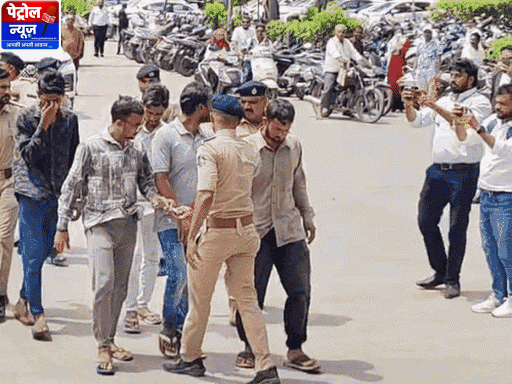


The five accused in the highly sensational Bhayali gang rape case in Vadodara have been sentenced to life imprisonment. On August 20, the Vadodara POCSO court convicted all five accused and announced the sentence.
On the second night of Navratri in 2024, a 16-year-old girl and her friend had gone to play Garba when five men reached the spot and raped and assaulted the minor. After announcing the sentence, the court also ordered Rs 10 lakh compensation for the victim. Importantly, this is the first time in Vadodara that five accused have been sentenced to life imprisonment together.
Government seeks maximum punishment: Anil Desai
Special Public Prosecutor Anil Desai said arguments were presented before the court regarding the punishment for the accused in the case. He said that according to the law and the maximum punishment under the sections applied in the case, the accused should be sentenced to life imprisonment until their last breath. He said that if the court did not consider the death penalty appropriate, the accused should be given life imprisonment as the maximum punishment.
Three accused raped the victim, two assaulted her
Public Prosecutor Nayan Sukhdwala said the prosecution had proved every piece of circumstantial evidence beyond doubt before the court. At the beginning of the incident, two of the five accused assaulted the victim. The remaining three then gang-raped her.
The victim’s mobile phone was also stolen during the incident and the court accepted the robbery charge. The accused threw the phone into the Vishwamitri river to destroy evidence. The court also accepted the evidence and statements of the fire brigade officials who tried to recover the phone, along with the medical evidence.
In a case based on circumstantial evidence, all the links in the chain of events have to be properly connected. The prosecution and police successfully presented these links before the court. The court found the evidence satisfactory and convicted all five accused.
Second night of Navratri becomes ‘Kalratri’ for minor
On October 4, 2024, the second night of Navratri, 16-year-old Sagira from Vadodara went to play Garba with her friend. The two were sitting in a deserted area of Bhayali when five men on two bikes reached the spot. The men took the keys of their two-wheeler and threatened them, saying they would call their families.
At first, the incident appeared to be a case of intimidation and robbery. However, within minutes, it took a serious turn.
The men asked Sagira where she lived and demanded her father’s phone number. When Sagira shouted for help, two of the accused fled. The remaining three threatened Sagira and her friend. When Sagira’s friend protested, the men held her. The three accused then attacked Sagira and gang-raped her.
Shocked by what had happened, Sagira and her friend did not know what to do. The taluka police station was only 2 km away, so they went there. Sagira told the police about the assault by the three men. The police were also shocked by the incident and immediately began the investigation.
The deserted crime scene made it difficult for police to identify the accused
The case was not a routine investigation for the police. The crime scene was deserted and there were no CCTV cameras. The biggest challenge was identifying the unknown accused.
The investigation then focused on technical surveillance and CCTV footage. Police examined CCTV footage from the crime scene and along the possible routes taken by the accused. More than 1,100 CCTV cameras covering a route of around 45 km were checked.
The accused were suspected to be hiding somewhere in Vadodara itself. A large number of police teams were deployed. More than 200 policemen searched the area around the crime scene.
More than 1,000 houses within a 3-km radius were also searched. Police tried to identify the accused by connecting CCTV footage with suspicious movements.
Police trace accused after call to Sagira’s stolen phone
The police investigation quickly produced results. Within 48 hours of the incident, three accused Munna Abbas Banjara, Mumtaz alias Aftab Banjara and Shahrukh Banjara were arrested. Saif Ali Banjara and Ajmal Sattar were arrested later.
The investigation found that all five accused were originally from Uttar Pradesh and had been living in Vadodara for years. They lived in the Tandalja area and worked as labourers and POP painters.
The accused had taken the minor’s mobile phone. At around 12.30 am, when the girl’s mother called the phone, one of the accused mistakenly answered it for three seconds before disconnecting. During those three seconds, the sound of drums and a DJ could be heard in the background.
A police team was sent to the location. Police then checked CCTV footage along the route to find out which bike the three accused were travelling on.
Another team analysed tower dump data. More than four lakh phone locations from five to six mobile towers were checked. Around 60 suspicious phone locations were identified near the crime scene and the place where Sagira’s phone had been answered.
Ten of these phone locations matched the route. Police collected details of the people linked to these numbers. One suspicious phone location led to Sushen-Tarsali Road. The phone belonged to Munna Banjara. His location was also found near the crime scene.
After the incident, the accused had tea at Rajwadi Hotel at around 1.30 am. This location gave police another important clue.
At midnight, police tracked Munna’s location and reached his house. His mother said he had gone out of the village, but his phone location was still nearby. Police searched the area and found Munna sleeping in a house three blocks away from his own home at around 1 am.
After questioning him, police arrested the other two accused, Mumtaz and Shahrukh. Based on the questioning of the three, the two accused who had fled earlier were also arrested.
The entire operation took place between 1 am and 4 am. Police had checked more than 1,100 CCTV cameras covering a 45-km route. The accused were identified within 48 hours of the incident.
After arresting the accused, the bigger challenge was proving the crime
The police’s responsibility did not end with the arrest of the accused. The biggest challenge was now to prove the crime in court.
Police and the SIT started collecting evidence one by one. Statements from the victim and her friend, other witness statements, CCTV footage, medical evidence, FSL reports and DNA-related evidence were collected.
Police worked to build a strong chain of evidence so that the entire sequence of events could be proved in court.
Police file 6,000-page chargesheet within 17 days
Just 17 days after the incident, police filed a chargesheet of around 6,000 pages in the POCSO court. It included statements from around 100 witnesses, FSL and medical reports, DNA samples and CCTV footage.
The state government also appointed special public prosecutors considering the seriousness of the case.
Sagira’s mobile phone became an important part of the investigation. One of the accused had taken her phone and later threw it into the river. Police tried to recover it, but the phone could not be found.
However, the investigation continued using other technical and scientific evidence. The case was therefore not based only on statements but was strengthened by scientific evidence.
During the trial, the prosecution examined 45 witnesses and presented various documentary and scientific evidence. Scientific evidence related to bodily fluids of the accused found on the minor’s clothes also became important in the case.
The prosecution argued that the evidence collected by police from the beginning was strong and that the case had been proved beyond doubt.
After the investigation, arrests, remand, identification parade, thousands of pages of chargesheet, witness statements and scientific evidence presented in court, the case finally reached the verdict stage.
On August 20, 2026, the special POCSO court in Vadodara convicted all five accused.
With the court’s decision, the charges against all five accused in this highly controversial case, which had been continuing for almost two years, were proved in court.
After arguments on the punishment were completed, the court sentenced all five accused to life imprisonment on August 31, 2026.