
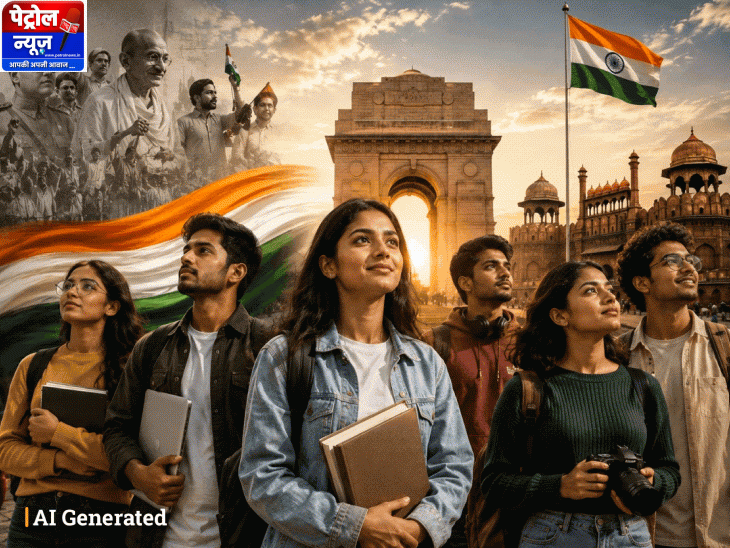


Nearly 80 years after India gained Independence, the meaning of ‘Azadi’ is changing for a generation that has grown up with smartphones, social media and access to diverse political and cultural ideas.
For Gen Z, broadly those born between 1997 and 2012, freedom is no longer understood only as liberation from colonial rule.
It increasingly means having the freedom to choose a career, question authority, express an identity, demand accountability, live with dignity and build a future on one’s own terms.
The idea has been shaped by everything from films and protest movements to unemployment, education, social media and changing social expectations.
From Independence to everyday freedom
India’s Independence in 1947 established political sovereignty, but for Gen Z, the question is increasingly about what that freedom means in everyday life.
The word Azadi has itself evolved over the decades. In 2016, student leader Kanhaiya Kumar used chants demanding freedom from hunger, discrimination and prejudice during student protests. The slogan later entered popular culture through the 2019 film Gully Boy, where it was associated with poverty, inequality and the struggles of working-class communities.
More recently, azadi has appeared in youth protests, including demonstrations linked to the NEET-UG paper-leak controversy, where students demanded accountability and reforms in the education system.
The issues may be different, but the underlying demand remains the same: greater freedom from conditions that restrict people’s choices and opportunities.
Why does Gen Z see freedom differently?
Gen Z is the first generation to grow up with the internet as a central part of everyday life.
Unlike previous generations, young Indians can access political debates, social movements and cultural perspectives from across the country and the world almost instantly.
Films also played an important role in shaping this generation’s understanding of social issues. Movies such as Rang De Basanti, Yuva, Lakshya and Aarakshan brought questions of political participation, inequality, caste and individual purpose into popular culture.
Social media has taken that conversation further.
A young person can watch a protest, encounter an unfamiliar social issue and participate in a political debate without physically being present at the event. A local grievance can become a national conversation through a reel, meme or viral post.
This has expanded the meaning of azadi beyond traditional political freedom.

For some, ‘Azadi’ means choosing their own life
There is no single Gen Z definition of freedom.
For some, it means choosing a career instead of following a profession selected by their parents. For others, it means deciding when or whether to marry, whether to have children, where to live or how to dress.
It can also mean questioning beliefs inherited from family or society, choosing one’s identity and refusing expectations based on gender, caste or tradition.
In this sense, freedom is increasingly personal.
It is the ability to decide what kind of life to lead without being forced into a predetermined idea of success.
For others, freedom starts with economic security
But personal choice is not equally accessible to everyone.
For many young Indians, Azadi is much more basic: the ability to get an education, find a job, earn a stable income and live with dignity.
A young professional may want the freedom to work remotely or leave a stressful job, while another young worker may simply want a job that allows them to support their family.
Similarly, a student from an economically disadvantaged background may see education itself as freedom, an opportunity to pursue a career beyond the work their family has traditionally done.
This creates vastly different definitions of freedom within the same generation.
One generation, different struggles
Class, caste, gender, religion and geography continue to shape how Gen Z experience freedom.
For one person, freedom may mean moving out of their parents’ home. For another, it may mean having enough money to remain in their hometown instead of migrating for work.
For someone, it may mean questioning an inherited identity. For another, it may mean being able to live openly without facing discrimination because of that identity.
The internet has made these differences more visible.
Young Indians increasingly encounter people whose lives and struggles are very different from their own. As a result, ‘Azadi is becoming less about one universal struggle and more about recognising multiple forms of inequality and exclusion.
Why protests matter to Gen Z
The recent student protests over the NEET-UG controversy provided an important example of this shift.
What began as anger over an education-related issue developed into a broader demand for accountability and institutional reform. Social media helped young people organise, share information and create a common language around the movement.
The protests also reflected a distinctly Gen Z style of dissent, combining street demonstrations with memes, reels, satire and online campaigns.
The Cockroach Janata Party, which emerged as a satirical online movement, became one example of how political participation is being reimagined through digital culture.
For many young people, the experience also challenged the perception that Gen Z is politically disengaged or confined to the digital world.
Azadi also means having a voice in politics
For some young Indians, freedom means having a greater role in political decision-making.
Gen Z is increasingly questioning why young people remain underrepresented in formal politics despite being a major demographic group.
This includes calls for political parties to create more opportunities for young candidates who do not come from established political families.
The argument is simple: if young people are expected to live with the consequences of political decisions, they should also have a greater say in making them.
The biggest change in the meaning of ‘Azadi’ may be this shift from freedom from something to freedom to do something.
In 1947, Independence meant freedom from colonial rule.
For Gen Z, freedom increasingly means the ability to build a life with agency: to study, work, speak, love, question, participate and make choices without being restricted by inherited circumstances.
That does not mean Gen Z rejects the significance of Independence.
Instead, it is asking what political freedom should have made possible for ordinary citizens nearly eight decades later.
So, what does azadi mean in 2026?
There is no single answer.
For one young Indian, it may be a job. For another, education. For someone else, it may be the freedom to leave home, choose a partner, question tradition or express an opinion without fear.
For many, it is simply the right to live with dignity.
The common thread is not a shared definition of freedom, but a shared belief that freedom should translate into greater agency over one’s life.
Nearly 80 years after 1947, Gen Z is not asking what India was freed from.
It is asking what Indians should now be free to become.
And that may be the newest meaning of ‘azadi’.