

Investigative Reporting Team | Patna7 hours ago

Government MBBS seats are allegedly being offered for sale for up to ₹18 lakh, with agents claiming that a candidate’s NEET rank does not matter and promising admission to government medical colleges in West Bengal, Rajasthan and other states.
An investigation by Dainik Bhaskar found agents allegedly offering to arrange fake domicile documents and NRI sponsorships to secure seats. Four undercover reporters contacted more than 50 agents and college representatives across five states as part of the investigation.

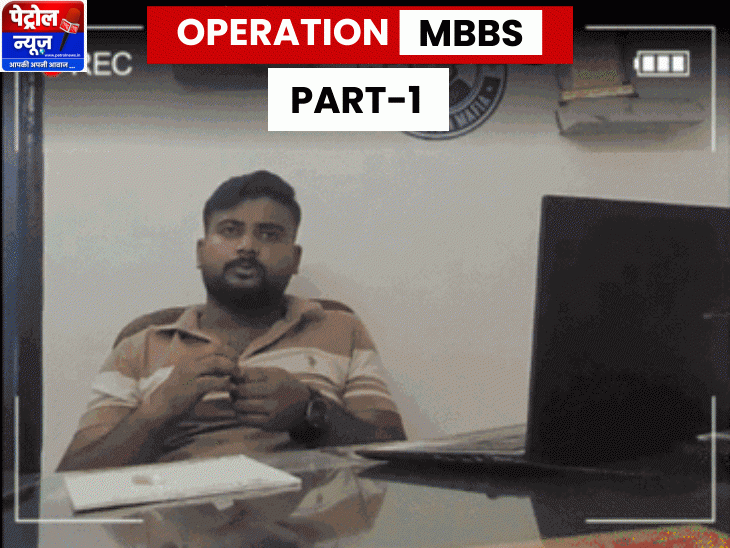
One agent, identified as Rupesh, claimed to have links with 11 government medical colleges in West Bengal.

“We have our setting in 11 government medical colleges in Bengal. Whatever your rank, spend ₹18 lakh and I will get you a seat in a government medical college. At a rank where people cannot even dream of getting a government medical college, you will get admission.”
The agent further claimed that seats were booked in advance by paying colleges ₹4-5 crore.


Agent claims candidate’s mother can be made a Bengal resident
Two undercover reporters approached Rupesh posing as general-category candidates. One claimed to have scored 325 marks in NEET, while the other claimed 540. Both said they could not secure government medical college seats at those scores.
Rupesh claimed he could arrange admission through the West Bengal domicile quota.
“I will give you a list of 11 government medical colleges in Bengal. Tell me which college you want admission in. You will have to wait until the second round of counselling.”
He claimed that a candidate from any state could be made eligible for the West Bengal quota by showing the candidate’s mother as a resident of the state.
“We have already bought 2-3 decimals of land there. We will put that address on the mother’s Aadhaar card. The Aadhaar number will not be changed.”
He allegedly offered to prepare documents showing that the mother had been living in Bengal for the past 10 years, along with a ration card and electricity connection.
“You arrange ₹18 lakh. The seat will be guaranteed. After that, you only have to pay ₹1 lakh a year as fees.”
He also offered an NRI quota option for ₹1.5 crore.
Another agent claims NRI route is ‘safer’
During the deal with Rupesh, the reporters received information about a Patna-based admission agent, Ravi. They visited his office in Boring Road, where several people were already discussing admissions to government medical colleges.
Ravi claimed to have connections in government colleges in West Bengal and Rajasthan.
“From Bengal to Rajasthan, we have our setting. We can get admission in Rajasthan through the NRI quota. The child will be safe through the NRI quota; there is some risk with domicile.”
He also claimed to arrange admissions in medical colleges in India, Nepal and Russia.
“At 430 marks, admission can be secured in a government medical college in Rajasthan through the NRI quota. ₹10 lakh will be charged for the setting and ₹5 lakh for preparing the papers.”
He claimed that an NRI sponsor was required and offered to arrange one for money.
“Spend the money and I will become the sponsor.”


More than six agents contacted in Patna
During deals with more than six agents in Patna, the investigation allegedly found links to government medical colleges not only in Bengal and Rajasthan but also in several other states.
To investigate the claims, Dainik Bhaskar reporters travelled around 600 km from Patna to Darjeeling in West Bengal and visited North Bengal Medical College, posing as parents seeking admission for two siblings.
There, they met a college counsellor, Arun.
College counsellor explains domicile process
According to the investigation, Arun said students with a low rank could potentially secure admission in Bengal if they had the required domicile documents.
“At your rank, you will not get admission in any government medical college in the country, but if you bring a domicile, it can happen in Bengal.”
He explained that different domicile forms apply depending on when a student completed Class 12.
“There are different proformas for domicile. Students who completed their Class 10+2 education from West Bengal before 2026 have one proforma, while students who passed Class 10+2 this year have another.”
He said the basic requirement was that the student or their parent should have been a long-term resident of West Bengal.
“The condition in both cases is that the student must have been a resident of West Bengal for a long time. The requirement is around 10 years of residence in the state.”
He added that students who had not themselves lived continuously in West Bengal could qualify if their mother or father was a resident of the state.
“If the mother or father is a resident here and has been continuously living in West Bengal, the domicile can be made on the basis of the parent’s residence.”
On document verification, Arun said:
“The college’s job is document verification. The documents brought by students will be checked through the department. The college does not have the authority to accept or reject any document outside the rules.”
More than 4,000 MBBS seats in Bengal’s 25 government colleges
The investigation found that West Bengal has more than 4,000 MBBS seats across 25 government medical colleges. Around 85%, or more than 3,400 seats, are under the state quota based on domicile.
It is these seats that agents allegedly claim they can secure for students from other states by arranging domicile documents.
How agents allegedly sell MBBS seats for ₹18 lakh
According to the investigation, agents first collect a student’s NEET score, rank and category, along with details of their state of residence and the state where they want admission.
They then allegedly offer candidates with low scores or weak ranks a way to qualify for government medical seats by changing family documents to show residence in West Bengal.
The alleged process includes:
- Preparing documents to show the student’s family as residents of West Bengal.
- Arranging documents such as address proof, voter ID and electricity connections.
- Using these documents to obtain a domicile certificate.
- Applying for medical counselling by presenting the student as eligible under the West Bengal state quota.
- Filing applications through Form-B using the alleged domicile documents.
- Arranging document verification through the agents’ network.
- Collecting money in instalments instead of demanding the entire amount upfront.
The agents allegedly demand money at different stages, including document preparation, verification and seat allotment.
According to the investigation, the ₹18 lakh domicile deal is divided into instalments. The process allegedly starts with a ₹2 lakh advance, followed by another ₹2 lakh after the documents are prepared and ₹2 lakh after document verification. The remaining amount is allegedly collected at the time of admission.
What are the risks of such admissions?
Question: Can admissions be secured this way and what are the risks?
Answer: The investigation found agents claiming that admissions could be arranged in this manner. Such practices can deprive eligible students of seats. If a complaint is made after an admission secured through fraudulent documents, the student could potentially lose the money paid, the seat and the degree.
What is domicile and how does it affect admission?
A domicile certificate is generally issued as proof of a person’s permanent or long-term residence in a state.
In West Bengal, around 85% of government MBBS seats are filled through the domicile-based state quota, making these seats a target for agents allegedly offering fraudulent documents.
Documents commonly required for domicile verification can include Aadhaar, voter ID, ration card, birth certificate, proof of residence of the mother or father, electricity bills and a declaration, depending on the applicable rules.

What is the NRI quota?
NRI refers to Indian citizens who live outside India. Under applicable rules, an Indian citizen who has been living, working or conducting business abroad for 180 days or longer may fall under the NRI category.
Proof of NRI status can include passport and visa documents, along with evidence of overseas residence. Income-related documents and proof of the relationship between the candidate and the NRI sponsor may also be required.
NRI seats are separate from regular government seats, and their fees vary according to the counselling rules of the respective state.
The investigation also found agents allegedly offering to arrange admissions using fake NRI certificates.
Coming up in Operation MBBS: Part 2
The next part of the investigation will examine alleged admission deals through the NRI quota in medical colleges across six states.