

Vinayak Sharma | Bhopal16 hours ago

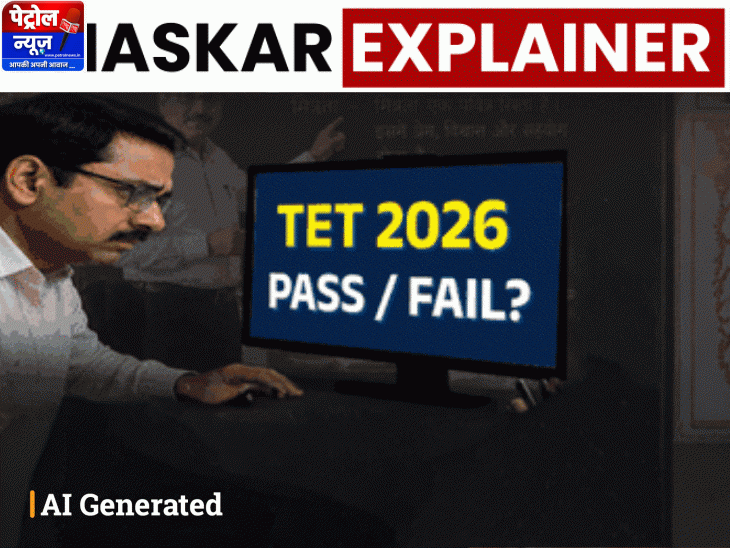
Teachers who have been teaching in schools for 15-20 years now face an examination that was never a condition of their appointment. Following a Supreme Court order, passing the Teacher Eligibility Test (TET) has become mandatory for serving teachers as well. In Madhya Pradesh, the exam date and syllabus have already been finalised.
Even with the exam approaching, teachers’ biggest worry isn’t preparing for the paper — it’s figuring out who actually needs to take it. Some are worried about losing their jobs, others about promotions being held up; teachers who already cleared the old TET/CTET are looking for different answers.
Why has the TET condition suddenly been imposed on teachers who have been teaching for years, and what happens to jobs and promotions if they don’t pass? Today’s Madhya Pradesh explainer breaks it down.
Question 1 — TET has existed before too, so why has it become such a big issue this time?
Answer — The Supreme Court passed an order in September 2025.
The order stated that teachers already in service must also pass TET. This is the biggest shift, because until now this was only a condition for fresh recruitment. This isn’t just a Madhya Pradesh issue — the same requirement is being applied to serving teachers in several states, including Uttar Pradesh, since the order applies nationwide.
Teachers argue that the TET requirement came in after the RTE Act of 2009, and was later extended to serving teachers as well. Their question is why the condition was applied retrospectively to those who were appointed before it existed.
This same objection has already been raised before the Supreme Court, and the court rejected it. When states and teachers’ associations filed a review petition in May 2026, their main argument was that the rule cannot be applied retrospectively, and that a 2010 NCTE notification had already exempted older teachers.
The court rejected both arguments, holding that Section 23(1) of the RTE Act deals with fresh recruitment, while the same section separately addresses teachers already in service — meaning the law’s intent, from the start, was that existing teachers must also acquire the qualification within a set time.
The judgment also noted that the teachers’ opposition is understandable and that the court is sympathetic, but that the fear of losing one’s job alone cannot be grounds for reconsidering an earlier ruling. According to the court, the RTE Act is a child-centred law, and teachers’ service cannot be placed above the future of children’s education.
Question 2 — So which teachers will now have to take TET?
Answer — This is where most of the confusion lies. Put simply, not every serving teacher has to take TET.
First — Teachers with less than 5 years of service remaining: » These teachers are exempt from the TET requirement.
Second — Teachers with more than 5 years of service remaining: » These teachers will have to pass TET. The court has given them time until 31 August 2028.
Third — Teachers seeking promotion: » TET is mandatory for them, regardless of how many years of service remain.
The state government itself is seeking relief from the Supreme Court for around 70,000 teachers recruited between 2005 and 2009. Its argument is that these teachers were appointed through older eligibility exams, and that the eligibility exams held in 2005 and 2008 should be treated as equivalent to TET.
According to Rakesh Dubey, state president of the Government Teachers’ Association (Shashakiya Shikshak Sangh), the government should clarify the status of teachers recruited in different rounds. For instance, teachers who joined under Operation Blackboard in 1988-92, those appointed on compassionate grounds in 1994-95, or the Shikshakarmi/contract teachers of 1998 — it is unclear which of these groups fall under TET’s ambit.
It also remains unclear whether teachers who have already passed TET or CTET can use their old certificates, or whether they will have to take the MP TET again — the current rulebook does not spell this out. Similarly, teachers who have already been promoted to a different post are still awaiting clarity from the department on their current status.
Question 3 — If a teacher fails to pass TET, will they lose their job? What happens to promotions?
Answer — Three things matter here.
Under the Supreme Court’s order, eligible teachers must pass TET within the stipulated time. Failure to do so could lead to action against their service. However, service benefits will be given as per rules, provided the teacher has completed the required period of service.
According to Rakesh Dubey, a departmental letter dated 2 March 2026 had already stated that failure to pass TET could result in removal from service, and that the exam would also be mandatory for promotion. There has been no clarity from the department since that letter. Even after the Supreme Court’s order of 29 May, teachers are still awaiting this clarity.
The court has given teachers until 31 August 2028 to pass TET, and has directed states to hold the exam regularly — likely twice a year. The court has also made clear that no further extension will be granted after this.

Question 4 — Despite having time until 2028, why are teachers worried already?
Answer — There are three reasons.
First, the rules are unclear — Dubey says that in any exam, along with the timetable, candidates know who is eligible to sit for it. Here, the date and syllabus have been announced, but the scope of eligibility is still not clear. Teachers’ associations have written to the commissioner objecting that the department is demanding TET from older teachers on one hand, while continuing to recruit or reappoint guest teachers without TET for the 2026-27 session on the other. Meanwhile, assistant teachers and higher-grade teachers have recently been given the benefit of promotion.
Second, the syllabus level — In April, the Commissioner of Public Instruction had said the paper would be at the level of Classes 1 to 8. Later, when the Selection Board released the syllabus, it appeared as heavy as graduation level in subjects like science. This objection is also reflected in the rulebook itself — in Category 2, the subject section worth 120 marks is at graduation level, even though the questions are meant to be linked to the Class 9-10 curriculum. In Category 3, questions will be based on the Class 1-5 curriculum, but the difficulty level could go up to high-school standard.
Third, the online exam and fees — Many serving teachers have no practice taking exams on a computer. Learning to scroll and mark answers alone could take up half their time. Vijay Krishna Mishra, a Category 3 teacher who has been teaching for a long time, says the difficulty isn’t just the syllabus or the technology — preparing for an exam at an older age is itself a challenge. Teachers’ associations have separately demanded a fee waiver, an offline exam, leave on the day of the exam, and travel allowance.
Question 5 — What will the exam pattern be, and what are the biggest questions right now?
Answer — The full exam pattern can be seen in the graphic below. However, there are a few things to keep in mind before filling out the form.
As per the rulebook, the fee is ₹1,000 per paper (plus ₹60 extra if filed through a kiosk). The form requires the appointment order, DISE code, and — for government teachers — a unique ID/IFMIS code. The photograph must have a white background with both ears visible. Mobile numbers and email addresses cannot be corrected later.
There is also a separate provision for teachers with disabilities. Candidates who are visually impaired, have a hand disability, cerebral palsy, or a mental disability can be given a scribe, compensatory time (an extra 50 minutes on a two-and-a-half-hour paper), or both — applications with supporting documents and an affidavit must be submitted at the board office 10 days before the exam.