

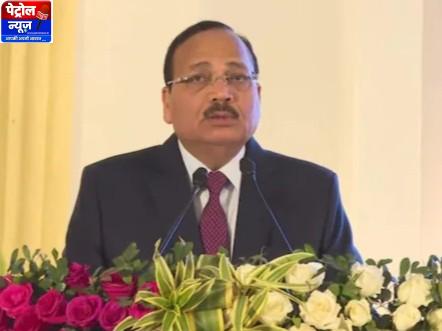


Chief Justice of India (CJI) Surya Kant stated that the Indian judiciary did not wait for parliamentary legislation to address new fraudulent cases like ‘digital arrest’. The judiciary has taken proactive action on such matters itself.
The CJI made these remarks on Saturday during the closing address of the 43rd International Symposium on Economic Crime in London. He mentioned that the Supreme Court has recently taken suo motu cognisance of the digital arrest scam.
In this scam, fraudsters pose as police officers, judicial officials, or bureaucrats via video calls to swindle people. The CJI stated that the court has directed the central and state governments to examine the scope of this problem.
Demand for creating a separate offense for digital arrest
The CJI said that the Supreme Court has demanded the creation of a separate offense for digital arrest and the determination of punishment based on the extent of the damage. He said, “This shows a broader picture. The Indian judiciary takes the initiative itself on new fraudulent cases and does not wait for parliamentary legislation.”
He stated that India’s modern system for dealing with economic offenses should not be viewed as a single law. This system is a multi-layered structure developed over several decades, in which the roles of laws, institutions, and judicial principles are clearly defined.
Mention of PMLA and Fugitive Economic Offenders Act
The CJI referred to the Prevention of Money Laundering Act (PMLA), 2002, and the Fugitive Economic Offenders Act, 2018. He noted that these systems are not entirely free from flaws.
He mentioned that many people have complained about the misuse of the PMLA process by investigative agencies. These include allegations of not providing clear reasons for arrest and keeping individuals in custody for longer than what is justified by existing facts.
The CJI stated that in every such case, the judiciary has intervened to rectify the situation. He also referred to the Supreme Court’s judgment, which stated that the grounds for arrest must be provided to the accused in writing, and merely reading them out is not sufficient.
Arrest in Kejriwal case deemed valid, yet bail granted
The CJI said, “I had the opportunity to write the judgment in the Arvind Kejriwal vs. Central Bureau of Investigation case. The court considered the arrest legal, but still granted bail.”
He explained that the basis for granting bail was that prolonged detention before trial should not be turned into a form of punishment.
The CJI stated that despite legal and technical changes, one thing has remained consistent for decades. Due process, proportionality, and the presumption of innocence are the guiding principles in the Supreme Court’s judicial system.
Civil recovery alongside criminal cases
Referring to the Insolvency and Bankruptcy Code (IBC), 2016, the CJI said that this law runs alongside criminal proceedings. The Indian judicial system has now become more comfortable in allowing parallel civil recovery in such cases, even if the criminal trial continues for a long time.
He said, “Like every country present in this auditorium, India has also learned from difficult experiences that Mutual Legal Assistance Treaties with other countries, despite the shortcomings in their processes and modalities, are far more reliable than extradition for bringing back any recovered assets to the country.”
He added, “After all, illicit assets do not stay for long in the place from where they were stolen.”
Money equivalent to a laptop for 8 billion people in the world in a year
The CJI said that if global estimates of money laundering are even roughly accurate, the world launders enough money in a year to buy a standard laptop for every one of the 8 billion people, with money still left over.
He stated that in this vast stream of illicit money, even by the most generous estimates, less than one out of every 100 units is ever recovered.
Kautilya wrote about the theft of government funds 23 centuries ago
The CJI said that the Indian statesman and teacher Kautilya, in his treatise ‘Arthashastra’ written on governance in the 2nd century BC, had mentioned various ways in which a government official could embezzle money from the state treasury.
He said, “Kautilya wrote a line that every compliance officer present here today, 23 centuries later, would understand. It is as impossible not to taste the honey or the poison that one may find at the tip of one’s tongue, as it is for the king’s officer not to eat up at least a bit of the king’s revenue.”
The CJI said that the nature of illicit wealth and economic crimes is such that both do not respect the sovereignty that generally protects legal systems from foreign interference.
He said, “The response of this symposium should be that vigilance, cooperation, and the rule of law curb fraud equally and, hopefully, at an increasingly higher level.”
In his concluding remarks, the CJI said, “The success of this symposium will not be measured by how well we have described the problem in this week. Its success will be determined by how hard each of us works to eliminate it upon returning to our respective countries.”