
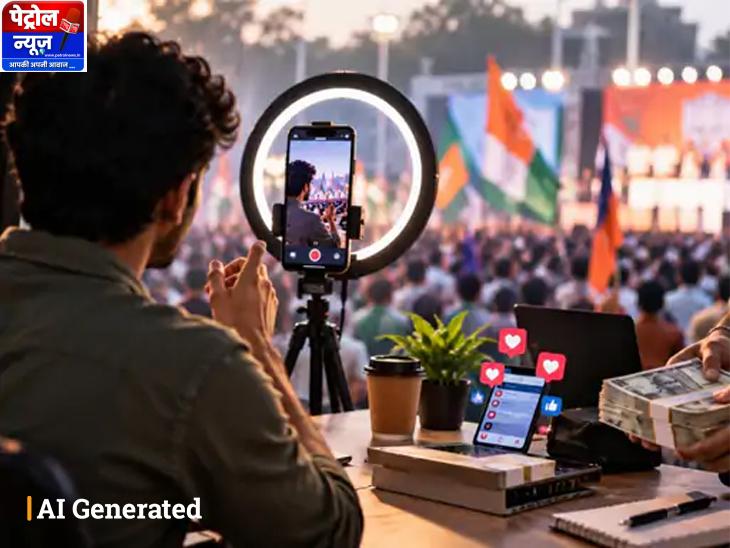


The traditional foundation of political parties’ strength has been their organisation and cadre. Now, alongside them, a ‘digital army’ of content creators and micro-influencers is emerging. They have neither a party post nor a flag, but they have the reach to thousands and even lakhs of screens.
Youth movements have demonstrated their power. Information about protests, narratives and questions to the government are no longer dependent only on rallies, posters or press conferences. A reel, meme or short video can reach lakhs of young people within a few hours.
Ahead of the Assembly elections in Uttar Pradesh, Punjab and Uttarakhand, parties are working to build networks of local influencers with 10,000 to 50,000 followers. According to people associated with digital campaigns, small and medium-sized influencers do not remain permanently associated with any one political party. At different times, they may work for the BJP, Congress, AAP or other parties.
More than 50 lakh subscribers can fetch ₹30 lakh
There are claims that creators are paid ₹15,000 to ₹50,000 for a political reel and ₹15,000 to ₹20,000 for a post. According to Shyam Tiwari, who runs a social media company, creators with up to 5 lakh subscribers charge ₹50,000 to ₹1 lakh. For a major creator with more than 50 lakh subscribers, the cost of a single piece of content can go up to ₹30 lakh.
Local influence matters more; governments have created rate cards
Parties assess creators based on their social reach, ideology and even body language. In some places, a teacher, farmer or comedian with 15,000 followers can be more influential than a national celebrity. Instagram influencers are being used for quick narratives, while podcasts are being used to build a leader’s image.
There are claims that political payments are being made in cash. The Election Commission regulates political advertising on social media and electoral expenditure. ASCI guidelines also require advertisements to be clearly disclosed.
But if a teacher praises an education policy, how will viewers know whether it is paid promotion? This will be a challenge for voters during the elections scheduled for 2027.
Creators have reach, workers have booths
Sudhanshu Vajpayee, associated with the Congress’s Gen-Z Connect Yatra, says, “Reels can bring more fame than a party worker. But bringing voters to the polling booth is still the worker’s job.” Sonam Wangchuk’s Ladakh campaign showed that digital support can translate into action on the ground.
Following the 2024 hunger strike, ‘Friends of Ladakh’ programmes were held in at least 50 cities. However, not every viral campaign necessarily translates into votes. Noor Sridhar, convenor of ‘Jago Karnataka’, also considers coordination between social media and booth-level management crucial.