

Yashpal Bakshi6 minutes ago

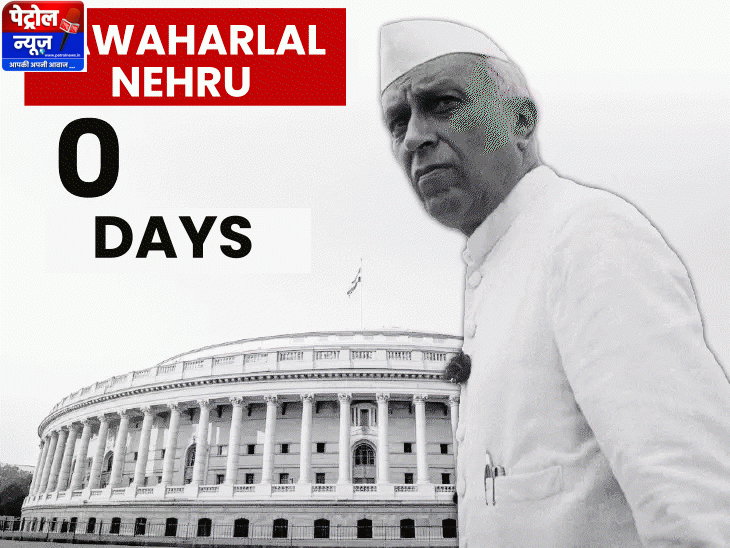
Prime Minister Narendra Modi is set to surpass a long-standing record held by India’s first Prime Minister, Jawaharlal Nehru, completing 4,399 days in office as an elected Prime Minister on June 10. The milestone comes amid continuing political debate, criticism and public scrutiny, a reality faced by every leader who occupies the country’s highest office.
Critics have always challenged those in power
History shows that every political leader has had both supporters and critics. Renowned poet and lyricist Majrooh Sultanpuri was among the vocal critics of Jawaharlal Nehru. In one of his controversial verses, he compared Nehru to Adolf Hitler, triggering a major political storm.
The poem led to the issuance of an arrest warrant by the then Bombay government. Majrooh went underground for a period before eventually being arrested by police during a gathering of Communist writers. He was taken into custody directly from the stage and spent nearly a year in Mumbai’s Arthur Road Jail.
The episode serves as a reminder that opposition to those in power is not new. Just as Nehru faced criticism during his tenure, PM Modi continues to face political opposition today. Yet both leaders remained focused on their respective agendas despite sustained criticism.
Modi set to overtake Nehru’s elected PM record
While Jawaharlal Nehru served as Prime Minister for around 16 years, his tenure as an elected Prime Minister began after India’s first general election in 1952, when the Congress secured power and Nehru assumed office through the electoral process.
From that point, Nehru remained Prime Minister for 4,398 days. On June 10, Narendra Modi will complete 4,399 days as an elected Prime Minister, thereby surpassing a record that has stood for more than six decades.
A historic political milestone
The achievement marks another significant milestone in Modi’s political career. Regardless of political differences, the record places him ahead of Nehru in terms of time served as an elected Prime Minister, making it one of the most notable moments in contemporary Indian political history.

Nehru held office longer, but Modi surpasses his record as an elected PM
Jawaharlal Nehru served as Prime Minister from 15 August 1947 to 13 May 1952, a period of 1,732 days. However, during those years he was not an elected Prime Minister, as India had not yet conducted its first general election.
Following the country’s first Lok Sabha elections in 1951-52, Nehru became India’s first democratically elected Prime Minister. He remained in office from 13 May 1952 until 27 May 1964, serving for 4,398 days as an elected Prime Minister. Including his tenure before the first election, Nehru’s total time in office stood at 6,130 days.
PM Modi is now set to surpass Nehru’s 64-year-old record for the longest tenure as an elected Prime Minister, marking a significant milestone in India’s democratic history.
Two leaders, two eras, one lasting legacy
Every Prime Minister, irrespective of political ideology, seeks to work in the nation’s interest. During his tenure, Modi has overseen a period of rapid economic growth and increased India’s global stature.
When Nehru assumed office, India was a newly independent nation grappling with poverty, food shortages and limited resources, operating on a budget of barely ₹500 crore. During that formative period, he laid the foundations of modern India by establishing institutions such as Indian Institutes of Technology (IITs), Indian Institutes of Management (IIMs), All India Institute of Medical Sciences (AIIMS) and Indian Space Research Organisation (ISRO), shaping the country’s long-term development trajectory.
While Nehru and Modi differ significantly in their political philosophies and governance styles, observers note that both leaders have left a profound imprint on India’s national journey. Their similarities and differences continue to be a subject of political debate and historical analysis.

What PM Modi Said About Nehru in Parliament
8 February 2022 | Lok Sabha
During a discussion on inflation in the Lok Sabha, PM Modi referred to comments made by India’s first Prime Minister, Jawaharlal Nehru, to counter criticism from the Congress over rising prices.
Modi remarked that the Congress often accuses him of not mentioning Nehru’s name, adding that on that particular day he would speak extensively about the former Prime Minister.
Quoting Nehru’s speech from the Red Fort PM Modi said, “Nehru had acknowledged that international events could affect prices in India. Nehru had stated that developments such as the Korean War, and even events in the United States, could influence commodity prices and inflation in India, despite occurring far beyond the country’s borders”.
Speech resurfaced amid global economic turbulence
The speech later gained significant attention on social media. Critics pointed out that Modi had appeared to mock the idea that events in distant countries could directly impact India.
However, the debate resurfaced after global geopolitical tensions, including the conflict involving the United States and Iran, led to fluctuations in international energy markets. Rising crude oil prices, higher fuel costs and pressure on the Indian rupee renewed discussions about the extent to which global developments can influence India’s economy.
9 February 2023 | Rajya Sabha
Speaking in the Rajya Sabha a year later, Modi referred to the continued prominence of the Nehru-Gandhi family in government schemes and public institutions.
The Prime Minister said, “I had read a report claiming that nearly 600 schemes and projects were named after members of the Nehru-Gandhi family. Some people become upset whenever Nehru’s name is not mentioned at official events”.
Modi added, While I may occasionally omit Nehru’s name, I have no hesitation in acknowledging him as India’s first Prime Minister”. He then questioned why members of Nehru’s own political lineage did not use the Nehru surname.
Modi questions absence of the Nehru surname
In one of the most discussed parts of his speech, Modi asked why successive generations of the family appeared reluctant to use the Nehru surname.
Modi stated “If Nehru was such a towering personality, why would anyone feel hesitant about carrying his surname?” He added, “There should be no reason to be embarrassed by a name associated with one of India’s most prominent political figures”.
The remarks triggered a fresh political debate, with the BJP and Congress once again clashing over Nehru’s legacy and his place in India’s political history.
Watch PM Modi’s full remarks in Parliament by clicking on the video below.
Credit: Sansad TV
[Analysis Point: Modi’s remarks about the Nehru surname triggered a nationwide debate, with Congress leaders strongly opposing the statement. Following the controversy, BJP Yuva Morcha National Secretary Tajinder Bagga tweeted that Jawaharlal Nehru’s family’s original surname was Kaul and that they belonged to the Kashmiri Pandit community.
He wrote that Nehru’s ancestor, Raj Kaul, had received land from Mughal Emperor Farrukhsiyar. As this land was located near a village called Nahar, the family came to be known as ‘Nehru’. Jawaharlal later adopted ‘Nehru’ as his surname instead of Kaul.
As time passed, a similar controversy emerged when Rahul Gandhi targeted the Modi surname. During a public meeting, he remarked that “Saare Modi chor hai” (All Modis are thieves. Following this statement, former Surat MLA Purnesh Modi filed a case against Rahul Gandhi.]
5 February 2024 | Lok Sabha
During his address in the Lok Sabha, Prime Minister Narendra Modi referred to a speech delivered by India’s first Prime Minister, Jawaharlal Nehru, from the Red Fort.
Quoting Nehru, Modi said: “People in India generally do not have the habit of working very hard. We do not work as much as people in Europe, Japan, China, Russia or America. Do not think those nations became prosperous by magic. They became prosperous through hard work and intelligence.”
Modi argued that Nehru’s remarks portrayed Indians as lazy and less capable, saying that the former Prime Minister appeared to be praising other nations while looking down upon his own people.
Nehru’s original speech later came under discussion
Modi’s remarks sparked considerable debate. However, a recording of Nehru’s original speech, later shared on social media by All India Radio, provided the broader context of what he had said from the Red Fort in 1959.
What Nehru actually said
In his full speech, Nehru stated, “People in India generally do not have the habit of working very hard. It is not entirely our fault as such habits develop over time. The fact is that we do not work as much as people in Europe, Japan, China, Russia or America. Do not imagine that those nations became prosperous by magic. They became prosperous through hard work and intelligence. We too can progress through hard work and intelligence. There is no other path.”
Nehru’s remarks were intended as a call for greater national effort and productivity, urging Indians to embrace hard work and innovation as the foundation for the country’s development and prosperity.
You can now listen to both speeches by clicking on the videos below
First, listen to what Prime Minister Modi said (Source: Sansad TV)
Now listen to Jawaharlal Nehru’s 1959 speech (Source: All India Radio Archives)
[Analysis Point: Narendra Modi argued in Parliament that Nehru’s speech suggested he considered Indians to be lazy and lacking intelligence. This interpretation was also challenged, and a clip of Nehru’s speech was later retrieved from the All India Radio archives, in which he was seen encouraging Indians to work hard and use their intellect.
Nehru’s intention was not to describe Indians as lazy or unintelligent. However, as is often the case, statements can be interpreted in different ways.]
February 7, 2024 | Rajya Sabha
Prime Minister Modi said Nehru believed that providing job reservations to SCs, STs and OBCs would lower the standards of government administration.
He stated, “I am quoting Pandit Nehru. Whatever Nehru said was treated as gospel by the Congress. On one occasion, Nehru wrote a letter to Chief Ministers in which he stated: ‘I do not favour reservations of any kind, and particularly not reservations in jobs. I am against any step that promotes inefficiency and leads to the creation of second-class standards.’
He further alleged that recruitment was stalled during that period and argued that, had appointments not been delayed, many eligible candidates would today have risen to senior positions through promotions.
July 29, 2025 | Lok Sabha
Modi went on to describe the Indus Waters Treaty as a major betrayal of India’s identity and self-respect.
He said, “Mortgaging India’s interests has long been a habit of the Congress. The biggest example of this is the Indus Waters Treaty signed by Nehru. It concerned India’s rivers and India’s water. These rivers have been part of India’s heritage for thousands of years. The Indus, which had symbolised India’s identity for centuries… yet Nehru handed over the authority to decide the distribution of rivers such as the Indus and Jhelum to the World Bank. The World Bank would decide who gets what. The rivers were ours, the water was ours…”
He argued that many young Indians would be surprised to learn that such decisions were taken by the country’s leadership. According to Modi, Nehru agreed to allocate 80% of the Indus river system’s waters to Pakistan, leaving India with only 20%.
“How was this considered wise? Where was the national interest in it? What kind of diplomacy was this?” Modi asked in Parliament.

[Analysis Point: Whether Nehru was right or wrong in signing the Indus Waters Treaty has been debated for decades and remains a subject of discussion even today. The fact is that the World Bank was acting as a mediator in the agreement at the time. Legally, under international norms, it was impossible for India, being the upper riparian state, to completely stop the flow of water to Pakistan.
Following Partition, tensions over canal waters had created a near-war situation between the two countries, making such a treaty necessary to ease the conflict. Thirdly, the agreement gave India full rights over the three eastern rivers namely the Sutlej, Beas and Ravi which helped make the Green Revolution possible in states such as Punjab and Rajasthan.
Since Operation Sindoor took place a year ago, India has suspended the Indus Waters Treaty and halted water flows towards Pakistan. The Modi government’s move to teach the hostile neighbour a lesson is also justified, and it has also created an opportunity to revoke the treaty.]
8 December 2025 | Lok Sabha
Politics around opposition to Vande Mataram by the Muslim League was intensifying. Muhammad Ali Jinnah, speaking from Lucknow on 15 October 1937, further escalated his opposition to Vande Mataram.
Following this, then Congress President Jawaharlal Nehru reportedly found his position under pressure. Instead of firmly countering the Muslim League’s allegations, he began examining the background of the Vande Mataram song itself.
Five days after Jinnah’s objection, on 20 October, Nehru wrote a letter to Netaji Subhas Chandra Bose. In that letter, Nehru stated that the Anandamath background of Vande Mataram could hurt the sentiments of Muslims.
He added that after studying the background of the song, he felt it could provoke Muslim communities. Following this, the Congress issued a statement announcing that a Congress committee meeting would be held in Kolkata on 26 October 1937.
It was also stated that the use of Vande Mataram would be reviewed in that meeting. The entire country was taken aback by this development. In that meeting, the Congress reached a compromise on Vande Mataram and decided to modify it by removing certain portions.
The decision was justified on the grounds of maintaining communal harmony. Critics viewed this as the Congress yielding to pressure from the Muslim League.
[Analysis Point: In Bankimchandra’s “Vande Mataram” the image of Bharat Mata is associated with Goddess Durga, a section of the Muslim League and some Muslim groups were unlikely to accept the song. For this reason, Jawaharlal Nehru was not in favour of adopting Vande Mataram as the national song of independent India.
Nehru also sought advice from Rabindranath Tagore on the matter. Tagore suggested to Nehru that only the first two stanzas of Vande Mataram should be sung publicly. Following Tagore’s advice, the song was shortened.]
5 February 2026, Rajya Sabha
Modi in his speech in Rajya Sabha once described how Pandit Nehru & Indira Gandhi thought about the people of India.
He said, “I will cite an example of what Pandit Nehru and Indira Gandhi thought about the people of the country. Once Indira Gandhi visited Iran, where she was delivering a speech. During the address, she referred to a conversation she had had with her father, Pandit Nehru. Indira Gandhi said in Iran that when someone asked her father, Nehru, how many problems he faced, he replied: 35 crore. Nehru’s answer was “35 crore”. At that time, India’s population was 35 crore. For Nehru, all 35 crore citizens were being described as a problem”.
Modi added, “Indira Gandhi further said in her speech that today the country’s population is 57 crore, so her “number of problems” is also equally large. The question then arises: can any Prime Minister consider their own citizens as a problem in this way?”


In 2018, Prime Minister Narendra Modi celebrated his birthday with children at a school in Varanasi. At that time, the children addressed Modi as ‘Uncle Modi’.
Read when and what Amit Shah said about Nehru in Parliament
6 December 2023, Lok Sabha
Amit Shah while addressing on Nehru said, “There were blunders during Nehru’s time, and Kashmir had to suffer because of them. I say with full responsibility that two major mistakes were made during Pandit Jawaharlal Nehru’s tenure as Prime Minister. These decisions led to long-term consequences, and Kashmir suffered for years because of them”.
He added, “The biggest mistake was that when our army was winning, a ceasefire was declared as soon as the territory of Punjab came into the picture, which led to the creation of Pakistan-occupied Kashmir (PoK)”.
He further said, “If the ceasefire had been delayed by just three days, PoK would have been part of India today. A ceasefire was declared without fully winning Kashmir. The second mistake was taking the matter to the United Nations. Both of these were not just mistakes but blunders committed during Nehru’s leadership”.
Now watch that video of Amit Shah in which he described Nehru’s two mistakes as blunders.
Credit: Sansad TV
[Analysis Point: If Nehru had not hastily taken the Kashmir issue to the UN and had instead given full operational freedom to the army, the whole of Kashmir would have been part of India.
Nehru had a close affinity with Kashmiri Muslim leader Sheikh Abdullah. Together, they added Article 370 to the Constitution of India, granting special status to Jammu and Kashmir. That is why Amit Shah used the word ‘blunder’ instead of ‘mistake’ for Nehru.]
19 July 2025, Lok Sabha
Amit Shah quoted Nehru’s decision of not including India into security council. He said, “I would like to quote a letter by Jawaharlal Nehru. Informally, the United States had suggested that China be admitted to the United Nations, but not to the Security Council. Instead, India could be included in the Security Council”.
He added, “In response to this proposal from the US, Nehru said that India would not accept it, as it could harm relations with China and may offend a great country like China. Today, China is a member of the Security Council, while India is still outside. This is attributed to Nehru’s stand at that time”.
10 December 2025, Lok Sabha
Amit Shah once also alleged that how Congress did manipulation of votes and chose Nehru over Sardar Patel. He said, “Congress members allege voter fraud, but I want to mention two or three incidents. The first case of alleged voter manipulation happened immediately after independence. At that time, the Prime Minister of the country was to be decided. Congress presidents from various provinces were to choose the Prime Minister, with each vote counting”.
He added, In that process, Sardar Patel reportedly received 28 votes, while Jawaharlal Nehru received only 2 votes. Yet, who became Prime Minister? Pandit Jawaharlal Nehru. How can this be explained?
[Analysis Point: On 25 April 1946, at a meeting of the Congress Working Committee in Delhi, not a single provincial committee had proposed Nehru’s name. Therefore, Acharya Kripalani, a close associate of Gandhi, proposed Nehru’s name in accordance with Gandhi’s wishes.
Kripalani put forward Nehru’s name, and at that moment Gandhi signalled to Sardar Patel to withdraw his name. Patel signed the paper withdrawing his candidature. By Gandhi’s will, Nehru became Congress President and later Prime Minister.
At that time, more than vote manipulation, Gandhi’s ‘willpower’ was the decisive factor. This account is written in Rajmohan Gandhi’s biography of Sardar Patel, ‘Patel: A Life’.]
Read when and what Atal Bihari Vajpayee said about Nehru in Parliament.
1999, Lok Sabha
Atal too once stated about how he felt after witnessing Pandit Nehru’s portrait in the Parliament. He said, “Nehru’s portrait used to be displayed in the South Block. I would see it every time I passed by. There were often sharp exchanges with Nehru in Parliament. I was new at the time and used to sit at the back in the House. At times, I would even walk out. Gradually, I found my place, moved forward, and when I became External Affairs Minister, I noticed one day that Nehru’s portrait was no longer on that wall in the South Block”.
He added, “I asked the staff where the portrait had gone, but no one had an answer. I then instructed that Nehru’s portrait should be put back on that wall”.
Listen to the speech delivered by Atal Bihari Vajpayee in 1999 by clicking on the video below.
Credit: Brut India
Atal quoted, “Feelings should be respected. But is there such an atmosphere of mutual respect in the country today? It is not that there were no differences with Nehruji. The differences would often come out in serious public debate”.
He added, “I once told Panditji that he had a mixed personality & said that there is Churchill as well as Chamberlain in him. He did not take offence. Later that evening, at a banquet, Nehruji met me and said, “You gave a very strong speech today,” and walked away smiling”.
He further said, “Today, making such criticism would be like inviting enmity. People would stop speaking openly. Should we not work together for the nation?”
[Analysis Point: There was healthy competition between the ruling party and the opposition. There was mutual respect, and Atalji’s speech is an example of this. The words spoken by Atalji in 1999 are relevant even in today’s context.
This is why Atalji was not only an exceptional statesman but also a visionary. Atalji had said: ‘Today, making such criticism is like inviting enmity.’]