
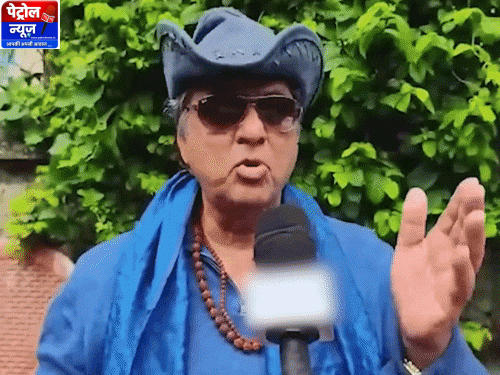


Shaktimaan actor Mukesh Khanna has called for the removal of India’s national anthem, Jana Gana Mana, and said that Vande Mataram should take its place. However, while making the statement, he made several errors about India’s national song and national anthem.
In a recent statement to IANS, Khanna said, “I said three years ago that Vande Mataram should be made the national song.” However, Vande Mataram is already India’s national song. He also referred to Jana Gana Mana as “Jana Mana Gana” and made claims about its history.

Khanna further said that Jana Gana Mana was written by Rabindranath Tagore in honour of Queen Elizabeth and questioned the words “Punjab Sindh”. He said that Vande Mataram, sung by Lata Mangeshkar, was the song that truly represented India.
Khanna says Vande Mataram should replace Jana Gana Mana
Khanna went on to say, “As soon as possible, remove this Jana Gana Mana and bring Vande Mataram.” He also said that Prime Minister Narendra Modi had started a movement around Vande Mataram and claimed that it had become mandatory for every school to sing it first.
He said that all seven stanzas should be sung instead of only three or four. Khanna also revealed that he is working on his own song, which he plans to release within six months.
Government issues guidelines on national anthem and national song
The central government has issued new guidelines to all states, Union Territories and central ministries regarding Jana Gana Mana and Vande Mataram. The Ministry has clarified that existing rules already specify which programmes require the national anthem and national song to be sung or played.
According to the guidelines, when both are part of the same programme, Vande Mataram will be played first, followed by Jana Gana Mana. States that have their own state song will also have to follow the prescribed sequence.
A letter containing the guidelines was sent to all states and ministries on 9 July, with details becoming public on Friday. The government has also asked that both songs be performed using their original words, correct pronunciation and the prescribed rules. Official copies have been uploaded on the Ministry’s website.
Earlier order issued on 28 January
The government had issued similar instructions to all states on 28 January. Under the earlier guidelines, the national song was to be played at the beginning of the day in schools.
Students are required to stand while Vande Mataram is being played or sung. The guidelines state that all six stanzas should be sung, with the complete version lasting around 3 minutes and 10 seconds. Earlier, schools generally sang only the first two stanzas.
Cinema halls, however, have been kept outside these rules. This means audiences are not required to stand or sing Vande Mataram before a film begins. If the song is played as part of a newsreel or documentary, viewers are also not required to stand.
Bankim Chandra wrote Vande Mataram in 1875
Vande Mataram, India’s national song, was written by Bankim Chandra Chatterjee on 7 November 1875, on the occasion of Akshaya Navami. It was later published in 1882 in his magazine Bangadarshan as part of his novel Anandamath.
In 1896, Rabindranath Tagore sang Vande Mataram at the Indian National Congress session. It was the first time the song was publicly performed at a national-level gathering. The performance moved many people in the audience.
The phrase Vande Mataram is derived from Sanskrit and means “O Mother, I bow to thee”. During India’s freedom struggle, the song became a powerful slogan for those fighting against British colonial rule.