

9 minutes agoAuthor: Swadhin Patel

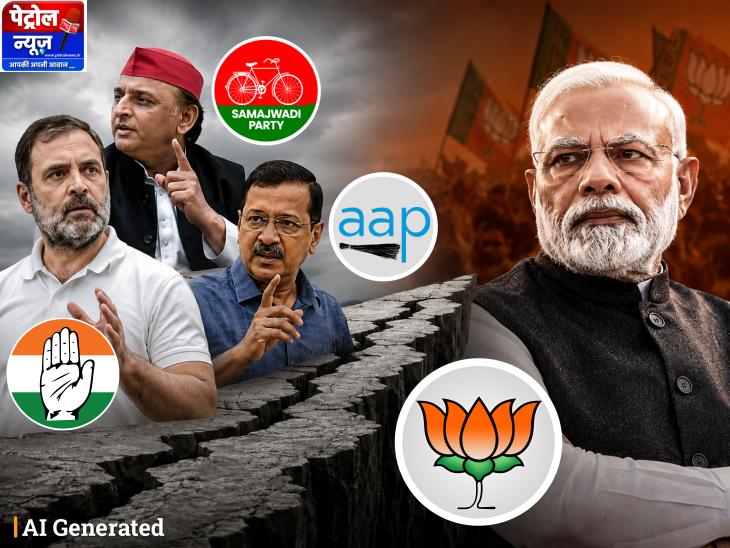
Opposition parties have intensified their attack on the BJP, but they are not speaking in one voice.
While they are broadly united against the ruling party, each has chosen to prioritise different issues.
Congress has kept its focus on national issues, particularly its attacks on Prime Minister Narendra Modi and Union Home Minister Amit Shah.
Samajwadi Party has centred its campaign on the Ram Mandir donation theft controversy, while Aam Aadmi Party (AAP) has highlighted the E-20 fuel policy.
Although these parties are supporting each other’s campaigns on certain issues, none is leading the other’s agenda.
This has raised questions over whether the Opposition lacks a unified strategy against the BJP or whether the differing priorities simply reflect each party’s electoral calculations.

Congress keeps its focus on national issues, avoids aggressive religious politics
Unlike some regional parties that have built their campaigns around specific issues, the Congress has largely kept its focus on national politics.
Political analyst Nikhil Jain described it as the party’s long-term political strategy.
He said Congress generally avoids taking an aggressively confrontational stand on religious issues, regardless of the religion involved.

Explaining why the party has not made the E-20 fuel policy a major campaign issue, Jain said the Congress has raised concerns over ethanol through its social media platforms, but its immediate priority remains national issues, including the demand for Amit Shah’s resignation.
The Ram Mandir donation issue, he added, comes next because of its political significance in North India.

Samajwadi Party prioritises Ram Mandir donation theft row as UP polls may take place in 6-7 months
With the Uttar Pradesh Assembly election just a few months away, the Samajwadi Party has made the Ram Mandir donation theft issue one of the central themes of its campaign.
Nikhil Jain said the party’s focus is closely linked to its electoral calculations in the state and its efforts to broaden its support base.

Jain added that the Samajwadi Party’s priorities are shaped by the upcoming Uttar Pradesh Assembly election, which is only a few months away.
He said this is why the Samajwadi Party is giving greater prominence to the Ram Mandir donation theft issue.

According to him, the Samajwadi Party believes that sections of the Brahmin community are dissatisfied with the BJP due to developments over the past one-and-a-half years, including OBC-related issues, the Manikarnika Ghat issue and what he described as a reduction in Brahmin dominance in Uttar Pradesh during Yogi Adityanath’s tenure.
Jain said highlighting religion-related issues more aggressively could help the Samajwadi Party attract Brahmin voters.

This is a picture of the part of the Manikarnika Ghat that has been demolished
AAP targets urban middle-class concerns through E-20 issue
Unlike the Congress and the Samajwadi Party, the Aam Aadmi Party (AAP) has centred its campaign on an issue that directly affects its core urban support base.
Political analyst Nikhil Jain said the party’s focus on the E-20 fuel policy reflects the concerns of the middle-class voters it primarily seeks to represent.

He said urban middle-class voters are directly affected by petrol prices and are more likely to own petrol vehicles.
Because of this, he said, AAP has chosen to build momentum around the E-20 fuel issue. He also noted that, like the Congress, AAP usually avoids taking a highly confrontational position on religious matters, though it may occasionally raise such issues.

Every party has its own electoral compulsions
While these different priorities have raised questions about whether the Opposition lacks a common strategy against the BJP, Nikhil Jain believes they are a natural outcome of the different political realities each party faces.
Nikhil Jain added this reflects the political and electoral compulsions of individual parties rather than any weakness in the overall Opposition campaign.
Jain said every political party has its own target voters, electoral priorities and political compulsions. Therefore, each party naturally prioritises different issues depending on its political objectives and upcoming elections.