
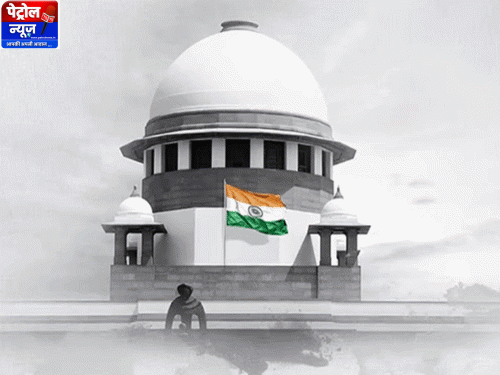


The Supreme Court has reduced the mandatory practice requirement for lawyers seeking to become Civil Judges (Junior Division) from three years to one year.
The court has modified its 2025 judgment, which had made three years of practice mandatory for recruitment to the entry-level judicial service.
A bench comprising Chief Justice Surya Kant, Justice Augustine George Masih and Justice K. Vinod Chandran issued the directions.
Justice Chandran dissented from the judgment, saying there was no basis to reconsider the earlier decision that required three years of practice at the Bar.
The court said that every candidate appearing for the Civil Judge (Junior Division) examination held after April 1, 2027, must have at least one year of practice.
The Supreme Court directed state governments to consult the respective High Courts and amend and notify the applicable service rules within three months.
Practice certificate and records mandatory
The court said practice would be verified through a Certificate of Practice. The certificate will be issued only when the candidate’s presence in court and participation in effective judicial proceedings are recorded under a system prescribed by the High Court.
The court said candidates selected through this recruitment process will undergo one year of intensive training at the State Judicial Academy. This will be followed by six months of law clerkship under a Principal District and Sessions Judge or a member of the Higher Judicial Service.
After that, candidates will undergo another six months of clerkship under a sitting judge of the concerned High Court.
All law graduates can apply during the transition period
For the transition period, the court said law graduates will be allowed to apply despite the earlier three-year practice requirement. For the purpose of applying, candidates will be deemed to have completed one year of active practice.
The court said, “All law graduates shall be eligible to apply notwithstanding the three-year practice requirement. More than a year has passed since the judgment under review was delivered. Therefore, for the purpose of applying, such candidates shall be deemed to have completed one year of active practice.”
Court retains requirement for practical experience
The court has not completely removed the earlier requirement for practical experience. Instead, it has changed the way in which the objective behind the three-year requirement will be achieved.
The bench said a person taking up a judicial position must have a sufficient understanding of how courts function. However, three years of practice at the Bar alone does not necessarily develop such an understanding.
The court said, “The purpose of the practice requirement is to ensure that a person taking up a judicial office has sufficient knowledge of the functioning of courts. As we have stated above, three years of practice at the Bar alone does not ensure this. In our view, practical experience and judicial competence continue to develop even after entering judicial service.”
The court said this objective can be achieved through a combination of limited practical experience before recruitment and structured institutional training after selection.
The court said, “The suggestions received after our order dated January 15, 2026, have also consistently highlighted the need to combine practical experience with robust institutional training.”
The bench distinguished between two separate questions. It said a person aspiring to become a Civil Judge must have some understanding of how courts function.
However, this does not mean that every aspect of judicial competence must be acquired through conventional Bar practice before the examination. The court said practical experience and judicial training can be developed through a combination of professional and institutional exposure.
The court observed that judicial academies have evolved considerably. They can teach skills through a structured and supervised process that a young lawyer might otherwise acquire unevenly during practice.
Reference to the Third All India Judges Association case
The Supreme Court also referred to the Third All India Judges Association case. In that matter, the court had removed the three-year practice requirement but recommended at least one year, and preferably two years, of training for new recruits.
The court also referred to the difficulties faced by lawyers because of the 2025 judgment. This included lawyers who had completed or were pursuing their legal education when the rules were changed.
For more than two decades, fresh law graduates could enter judicial service without a prescribed period of prior practice. The 2025 judgment made three years of practice mandatory even to appear for the examination.
The court said that requiring three years of practice merely to sit for the examination could delay a young lawyer’s entry into judicial service by several years.
The bench also noted that young lawyers without strong professional networks or financial support may struggle to find meaningful opportunities to practise. Women candidates and persons with disabilities may also face difficulties in accessing opportunities for practice.
The court said the new arrangement was a limited intervention. It was not holding that the three-year requirement was inherently unreasonable.
Instead, it has combined one year of practice with intensive training and supervised clerkships. This will give candidates courtroom exposure as well as institutional preparation for judicial office.
Justice Chandran backs three-year practice requirement
Justice K. Vinod Chandran dissented from the majority decision modifying the three-year practice requirement.
He said the earlier judgment was a considered decision of a three-judge bench and there was no basis for reconsidering it. According to him, experience at the Bar is essential for lawyers entering the judicial service.
Justice Chandran said judicial service cannot be compared with other government services because the work of judicial officers is fundamentally different.
He said a judge independently decides matters concerning life, liberty, property and reputation. Judicial decisions are not subject to ordinary administrative supervision.
He rejected the argument that three years of practice has limited value because young lawyers may not get cases or opportunities to argue in their initial years.
Justice Chandran said lawyers learn during their early years by working on files, observing court proceedings, interacting with other members of the Bar and watching how trials and arguments are conducted.
He said skills such as drafting, research, cross-examination and preparing arguments also develop through practice.
Justice Chandran also opposed the structured training system introduced by the majority. He said candidates with one year of practice would have to spend two additional years in training and clerkships.
This could affect their salaries and delay their entry into regular judicial service. He also raised concerns about whether the same or different training systems would apply to different categories of candidates.
He said most High Court Bars were in favour of requiring experience. Academic qualifications alone cannot replace the experience of real-life litigation.
Justice Chandran said, “The legal and analytical ability of a decision-maker is better learnt in the profession by observing court proceedings. Not necessarily by conducting proceedings as a presiding officer, but as a serious and keen student of law. The courtroom is the deepest classroom of all classrooms.”
He concluded that three years of practice should be mandatory before lawyers enter the judicial service.
He said, “With all respect and deep regret, I dissent. In my view, there is no scope for reconsidering a considered judgment.”
Plan to be reviewed after five years
The majority said the new scheme should not be treated as a permanent arrangement.
The court directed that the scheme will remain in force for five years from the date of the judgment. According to the court, this period will provide sufficient institutional experience to assess the impact of combining limited practice, structured training and supervised clerkships.
After five years, data on recruitment quality, the usefulness of training and clerkships, the performance of judicial officers and other relevant factors will be placed before the court. The court said the scheme may be reviewed again if necessary.
Three senior advocates appeared for petitioners
Senior advocates Pinky Anand, Vibha Makhija and Colin Gonsalves appeared for the petitioners and those who filed the review petitions. Bhoomika Trust was among the petitioners.
Senior Advocate Pinky Anand welcomed the judgment. She said it would resolve the difficulties faced by candidates preparing for judicial service and introduce a new model for training Civil Judges.
Anand said, “The judgment has resolved the retrospective difficulties faced by candidates. Going forward, this could prove to be a revolutionary step in changing the way Civil Judges are trained. Personally, I believe this will help produce more capable and better judges at the district level.”
She also welcomed the court’s decision to review the model on the basis of facts after five years. She said this would help strengthen judicial services and support efforts to increase the number of women judges in India.