
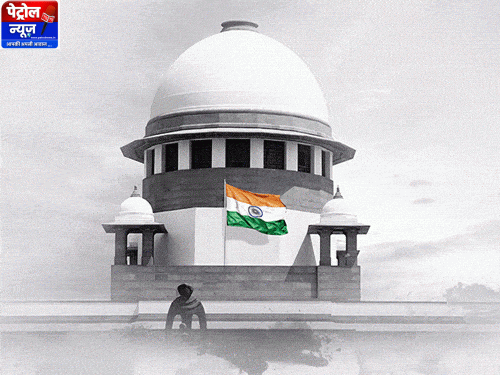


The Supreme Court on Monday sought the central government’s clarification on key provisions of the 2025 SHANTI Act, including whether courts remain empowered to award fair and just compensation in the event of a nuclear accident despite statutory limits on operator liability.
The court also asked the Centre to respond to concerns over a possible conflict of interest in the appointment of members to the Atomic Energy Regulatory Body (AERB).
The case was brought by a group of petitioners, including professors and scientists led by former bureaucrat EAS Sarma, who have challenged the constitutional validity of provisions of the Sustainable Harnessing and Advancement of Nuclear Energy for Transforming India (SHANTI) Act, 2025.
A bench comprising Chief Justice of India Surya Kant and Justices Joymalya Bagchi and V Mohana issued limited notice on the challenge to the legislation.
Court examines scope of compensation
The petitioners have argued that the legislation violates fundamental rights guaranteed under Articles 14, 19 and 21 of the Constitution.
Appearing for the petitioners, advocates Prashant Bhushan and Neha Rathi submitted that the law places a cap on liability in the event of a nuclear accident.
Chief Justice Kant, however, questioned whether such a statutory ceiling necessarily prevented courts from providing additional relief to victims. He observed that even if Parliament had limited the liability of nuclear plant operators, it would not necessarily prevent a court from awarding fair and just compensation.
The Chief Justice also noted that Parliament had enacted the legislation with the objective of incentivising project proponents and attracting investment into the nuclear energy sector.
Bhushan countered that limiting liability could have implications for safety, arguing that the provision could effectively allow operators to “cut corners on safety”.
Questions over nuclear regulator appointments
The bench also sought the Centre’s position on the appointment process for members of the Atomic Energy Regulatory Body.
The issue concerns Section 17(4) of the SHANTI Act, under which members are recommended by a search and selection panel constituted by the Atomic Energy Commission.
Bhushan argued that the arrangement could create a conflict of interest because the Atomic Energy Commission is responsible for operating atomic power stations in the country, while the body is also involved in recommending members of the regulator tasked with overseeing the sector.
The Supreme Court has therefore asked the Centre to clarify whether such an arrangement creates a conflict of interest and explain its position on the appointment mechanism.
Law opens nuclear power sector to private companies
The SHANTI Act represents a significant change in India’s nuclear energy framework. It replaced the Civil Liability for Nuclear Damage Act, 2010, and allows private companies to establish civil nuclear power plants.
However, the legislation limits the liability of private operators to Rs 3,000 crore in the event of an accident or other unfortunate incident at a nuclear power plant.
It is this liability framework that has become one of the central issues in the constitutional challenge before the Supreme Court.
The petitioners have raised concerns over whether the statutory cap adequately protects people who could be affected by a nuclear accident and whether the legislation strikes the right balance between encouraging investment and ensuring accountability.
Court had earlier flagged economic policy dimension
The Supreme Court had previously considered the challenge on May 19, when it observed that the issues raised by the petitioners concerning various provisions of the SHANTI Act appeared to touch upon “economic policy”.
The latest proceedings indicate that the court is nevertheless examining specific legal and constitutional questions arising from the legislation, particularly the extent of judicial powers over compensation and the independence of the nuclear regulatory framework.
The Centre’s response to the limited notice issued on Monday is now expected to clarify whether the liability ceiling affects the courts’ ability to provide additional compensation and whether the process for appointing AERB members adequately safeguards regulatory independence.