


Marathi cinema has recently gained international attention after Santosh Davakhar’s Gondhal was selected as India’s official entry for the 2027 Oscars. The film was chosen by the Film Federation of India from 33 submissions in the International Feature Film category.

Maharashtra Chief Minister Devendra Fadnavis congratulated the team and called the selection a “moment of pride for Marathi cinema”. Rooted in Maharashtra’s folk traditions and culture, the film will now represent India on the international stage.

This is yet another sign of how Indian cinema is expanding beyond a single language or film industry.
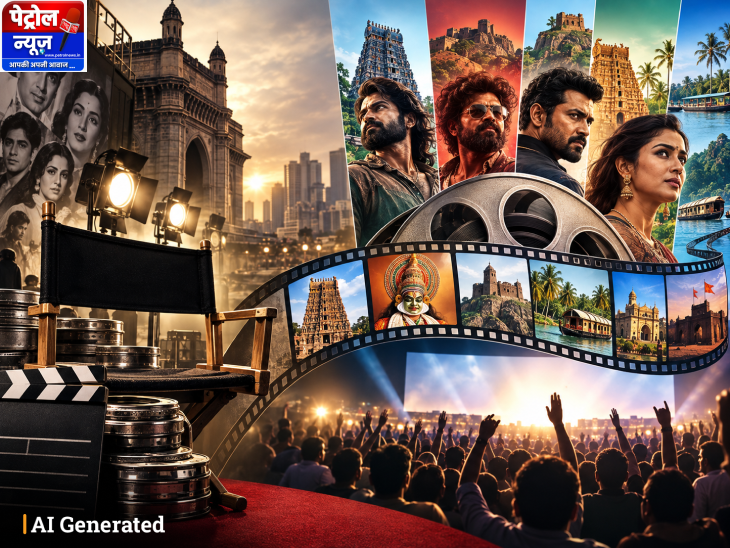
For decades, Mumbai was seen as the unofficial centre of Indian cinema. Hindi films had the biggest stars, the widest theatrical reach and a strong influence on popular culture. For much of the country, Hindi cinema was almost synonymous with “Indian cinema”.

Films made in Telugu, Tamil, Malayalam and Kannada, meanwhile, were largely viewed under the separate label of regional cinema.
Bollywood has lost its monopoly over the national audience
The change is not simply that South Indian films are producing bigger blockbusters.
The deeper shift is that audiences outside the original language markets are increasingly treating these films as their own. A Telugu film can become a Hindi-market blockbuster. A Malayalam film can become a national word-of-mouth phenomenon. A Kannada film can turn a local cultural story into a nationwide event.

India’s theatrical market generated ₹11,833 crore in gross box office revenue in 2024. Hindi cinema remained the largest individual language market, with ₹4,679 crore and a 40% share. But the four major South Indian languages — Telugu, Tamil, Malayalam and Kannada — collectively accounted for 48% of India’s box office in 2024, according to Ormax’s language classification.

2025 was a Hindi comeback year
The Indian box office reached a record ₹13,395 crore in 2025, while Hindi cinema itself reached an all-time high of ₹5,504 crore, accounting for 41% of the market. The combined share of Telugu, Tamil, Malayalam and Kannada fell to 44%.

So this is not a story about Bollywood being defeated. Bollywood can still be India’s largest single-language industry without being India’s unquestioned centre.
The South did not rise as one industry
Calling it “South cinema” is useful for understanding the broad shift, but there is no single South Indian formula.
Telugu cinema built its strength around scale, spectacle and the ability to turn stars into pan-India brands.

Tamil cinema has long combined superstar culture with a much broader range of genres, filmmakers and political and social themes. Malayalam cinema demonstrated that strong writing, character-driven stories and relatively controlled budgets could travel far beyond Kerala. Kannada cinema showed that local stories and cultural identity could become national theatrical events.
Telugu cinema turned scale into a national language
Baahubali demonstrated the commercial potential of this model. Then came RRR, Pushpa and Kalki 2898 AD, along with dubbed releases, nationwide marketing and multilingual distribution.
Pushpa 2: The Rule was primarily a Telugu film, starring Allu Arjun and directed by Sukumar.

Yet its Hindi version became one of the biggest Hindi-language theatrical successes ever recorded. According to Ormax, Pushpa 2 generated ₹1,403 crore gross in India, while its Hindi-dubbed version alone contributed ₹889 crore.
Malayalam cinema proved you don’t need ₹500 crore to go national
Malayalam cinema represents the opposite lesson. It showed that national scale can emerge from storytelling rather than production scale.

Manjummel Boys, the Malayalam survival drama, was made on a relatively modest budget compared with India’s largest commercial films. Yet it became a major theatrical success outside Kerala, particularly in Tamil Nadu, and eventually grossed around ₹242 crore worldwide according to reported box-office figures.
The film did not need a pan-India superhero franchise or a Bollywood superstar. It did not need to abandon its Malayalam identity. The story itself travelled.
Streaming broke the language wall
For decades, language was a geographic barrier. Streaming changed that. Subtitles became normal. Dubbing became normal. Audiences began discovering actors without knowing their language.

A viewer in Delhi could discover a Malayalam thriller. Someone in Bengaluru could watch a Tamil drama. A Hindi-speaking viewer could follow a Telugu franchise. The discovery process became almost frictionless.
And once an audience becomes comfortable crossing languages at home, crossing languages in theatres becomes easier too.
The old hierarchy is breaking
The old question was: “Which language is the film in?” The new question is increasingly: “Is the film worth watching?”
A Telugu film can now dominate the Hindi market. A Malayalam film can become a national word-of-mouth hit. A Kannada film can become one of India’s biggest theatrical releases. A Tamil filmmaker can direct a Hindi blockbuster.

The market is therefore moving from a centre-and-periphery model to a multi-centre model.
India no longer has one cinema
The old Indian film industry had an obvious centre: Mumbai. The new Indian film industry has several.
Hyderabad can produce the next national spectacle. Chennai can produce the next superstar-driven experiment. Kochi can produce the next word-of-mouth phenomenon. Bengaluru can turn local folklore into mainstream entertainment. Mumbai can still produce the country’s biggest Hindi hits.
The South did not destroy Bollywood. It changed the rules. Bollywood remains powerful, but it no longer gets to define what Indian cinema is by itself.