



People from the Muslim community sleeping in the Gurudwara premises
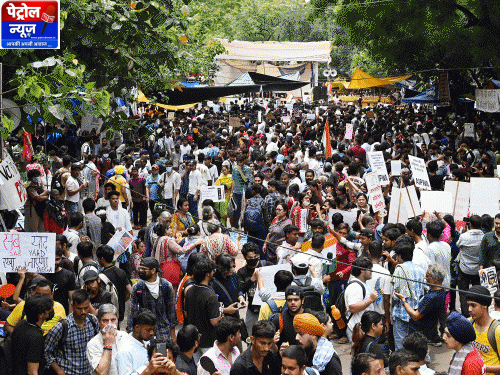
Hundreds of Muslims visiting Rauza Sharif Dargah on the occasion of the Urs spent the night at Fatehgarh Gurudwara Sahib. The Diwan Hall and outer premises of the Gurudwara were filled with members of the Muslim community, with many resting overnight while others were seen moving around the premises.
Video goes viral on social media, in which some people from the Muslim community are seen walking around the Gurudwara premises wearing caps and some bareheaded.
On social media, lying down and walking bareheaded in the Gurudwara premises is being described as a violation of the purity of Gurudwara Sahib.
People have urged the Shiromani Gurdwara Parbandhak Committee (SGPC) and Gurdwara managements not to provide space to anyone who fails to respect the sanctity of Gurdwara Sahib.
Gurdwara managers, too, maintain that members of the Muslim community should have followed the established protocol and observed the decorum of the Guru’s house while staying at the Gurdwara Sahib.
The manager said, “The place where this video is from is outside the Charan Kund, but the protocol should have been followed there as well. They say that full attention will be paid to this in the future and no one will be allowed to violate the sanctity in this manner.”

People from the Muslim community lying in the Gurdwara Sahib premises in Fatehgarh Sahib
Social media sparks debate
Videos showing people sleeping and moving around the Gurdwara premises without covering their heads, and even entering while wearing caps, have gone viral on social media raising a rather startling question.
When covering one’s head is considered essential before entering the Guru’s house, how were people allowed to enter and roam around the Gurdwara premises without following this basic protocol?
Besides this, questions are also being raised about wearing caps in the Gurdwara premises. People’s argument is that during the martyrdom fair, even caps from children’s heads were removed and placed on spears, so why were people wearing caps allowed to roam in the Guru’s house now? These videos are said to be from between 10 to 13 August.

A large number of people from the Muslim community arrived outside the Fatehgarh Sahib Gurdwara
SGPC, Gurdwara managers offer differing views
- “This is a video of the plaza, there are no restrictions here”: SGPC member Gurcharan Singh Grewal said, “In the video going viral of Gurdwara Fatehgarh Sahib, people from the Muslim community are lying down in the plaza which is an area outside the Gurdwara Sahib.”He added, “Covering the head is not mandatory there. Everyone should see that when coming near the Gurdwara Sahib, decorum should be maintained. Those who were lying there should have covered their heads.”
- Area outside Charan Kund: Gurdwara Sahib manager Gurdeep Singh Kang said, “People come here from across the country and abroad during the Urs. There is no place for them to stay in Fatehgarh Sahib.”He stated, “They are provided accommodation in the Gurdwara Sahib. This time too, when the Urs was celebrated from 10 to 13 August, a large number of people stayed in the Gurdwara Sahib.”He added, “The area shown in the video is the area outside Charan Kund. Wherever it is in the Gurdwara premises, decorum should have been maintained. It would have been good if the people sitting in this premises had covered their heads. This will be taken care of in future. The Diwan Hall was full, that’s why they were lying outside.”

Alif-Sani’s connection with Fatehgarh sahib
He was born in 1564 AD in the historic city of Sirhind, in present-day Fatehgarh Sahib. He spent much of his life here studying and teaching Islamic scholarship and Sufi philosophy.
He passed away in Sirhind in 1624 AD. His shrine, known as Rauza Sharif, is located in Fatehgarh Sahib and today serves as a major pilgrimage site for devotees from across the world.
Because of his deep and enduring association with Sirhind, he came to be widely known as Sheikh Ahmad Sirhindi.
The mutual support and cooperation between Sikh and Muslim communities during the annual Urs make Fatehgarh Sahib a remarkable example of interfaith harmony and religious brotherhood.