
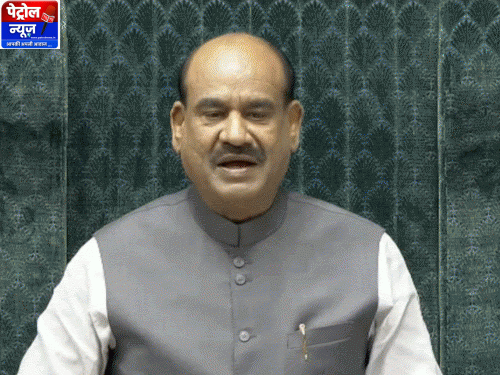


On the eighth day of Parliament’s Monsoon Session, Lok Sabha held a nine-hour debate, from 2 pm to 11 pm, on the Public Examinations (Prevention of Unfair Means) Amendment Bill, 2026, which aims to address paper leaks.
The House was adjourned at 11 pm. On Wednesday, the Lok Sabha will vote on the Bill, while it will be introduced and discussed in the Rajya Sabha.
The Bill proposes amendments to the law enacted in 2024. Minister of State Jitendra Singh said the changes would help prevent paper leaks.
The appointment of Prahlad Joshi as Education Minister also sparked protests in the Lok Sabha on Tuesday. Outside Parliament, Rahul Gandhi alleged that the government had made “a person who defended a rapist” the Education Minister. Priyanka Gandhi made a similar remark in the Lok Sabha, though her comment was later expunged from the House proceedings.

Current paper leak law: 4 key points
No central law until June 2024: Until June 2024, India had no single central law to deal with paper leaks. Cases were registered under provisions related to cheating, criminal conspiracy and forgery, which did not have stringent bail conditions.
States enacted separate laws: Some states introduced their own anti-cheating laws and invoked the Prevention of Money Laundering Act in certain cases. In Uttar Pradesh, the Gangsters Act was also applied in some instances.
Law enacted after NEET-UG and UGC exam irregularities: Following irregularities in the NEET-UG and UGC examinations, the Centre enforced the Public Examinations (Prevention of Unfair Means) Act on June 21, 2024. The law criminalised paper leaks, assisting in leaks, illegally obtaining OMR sheets, facilitating cheating, creating fake exam-related websites, and threatening examiners.
Non-bailable offences with two categories of punishment: All offences under the Act are non-bailable. Those involved in paper leaks and related offences can face three to five years’ imprisonment and a fine of up to ₹10 lakh. If directors or management officials of an examination-conducting body are found guilty, they can face three to ten years’ imprisonment and a fine of up to ₹1 crore.

Why was a new bill needed?
The NEET-UG 2026 paper leak controversy severely dented public confidence in the examination system. The exam impacts nearly 2 million aspirants.
Several paper leak incidents in NEET, recruitment and other competitive exams over the past few years led to cancellations and disrupted recruitment processes.
Students across the country staged protests. The Cockroach Janta Party (CJP) led a 36-day agitation, increasing pressure on the government to reform the examination system and enact a stricter law. The controversy eventually led to Dharmendra Pradhan’s resignation.
The Opposition accused the government of failing to safeguard the examination system and demanded accountability from officials and examination agencies, rather than relying solely on a new law.

NEET paper leak case: 13 arrests so far
The NEET-UG 2026 examination, held on May 3, was allegedly leaked. The government and the National Testing Agency (NTA) subsequently cancelled the examination and conducted a re-test. Several students across the country reportedly died by suicide during the controversy.
The Cockroach Janta Party staged a month-long protest at Delhi’s Jantar Mantar over the issue. Sonam Wangchuk observed a 26-day hunger strike, while Opposition MPs repeatedly raised the matter in Parliament.
The CBI is currently investigating the case, with searches conducted in Maharashtra, Rajasthan, Delhi and other states. Thirteen people have been arrested so far, and the agency is expected to file its chargesheet soon.