


Just a month after the Cockroach Janta Party supporters laid siege to Jantar Mantar, demanding the resignation of then Education Minister Dharmendra Pradhan over the NEET paper leak, the iconic protest site is once again at the centre of a major public agitation. Again, the issue is very close to Gen Z– employment. This time, however, it is not exam irregularities but the reservation system.
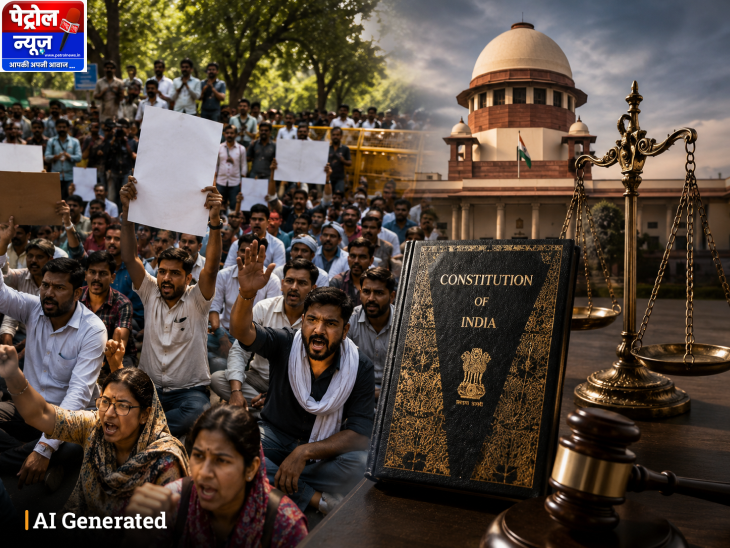
Thousands of protesters gathered in central Delhi on Friday under the banner of the ‘Reservation Hatao Andolan’, calling for an end to caste-based reservations in education and government jobs. The demonstration prompted authorities to turn the area into a high-security zone, with heavy deployment of Delhi Police and paramilitary personnel around Jantar Mantar to maintain order.
As the protests continue to swell, let’s take a look at what the protesters are demanding and more importantly are their demands legally tenable?
What triggered the ‘Reservation Hatao Andolan’?
The organisers of the protest say the movement is aimed at challenging the existing reservation framework, which provides quotas in education, public employment and political representation for Scheduled Castes (SCs), Scheduled Tribes (STs) and Other Backward Classes (OBCs).
Participants argue that reservations based on caste should be replaced with a system that focuses solely on economic disadvantage. Protesters have also raised concerns about what they describe as unequal treatment under certain laws and have called for wider reforms to policies linked to caste-based affirmative action.
The agitation has drawn participants from several states and has gained traction on social media, where campaigners have used the slogan ‘Reservation Hatao’ to mobilise support.
What are the protesters demanding?
First, protesters are seeking an end to caste-based reservations in educational institutions and government jobs. They argue that benefits should be extended only to economically weaker individuals, irrespective of caste or community background.
Second, some groups associated with the protest have demanded the repeal of the Scheduled Castes and Scheduled Tribes (Prevention of Atrocities) Act, commonly known as the SC/ST Act. They contend that the law is susceptible to misuse, a claim that has been repeatedly debated in political and legal circles.

In addition, some groups participating in the protest demanded the introduction of a creamy-layer criterion across reservation categories and sought a broader review of policies relating to Scheduled Castes, Scheduled Tribes and Other Backward Classes.
‘Quota only for the poor’: The economic-criteria argument
A central demand of the protesters is that reservations should be granted exclusively on the basis of economic status rather than caste.
Supporters of this view argue that poverty affects individuals across communities and that affirmative action should therefore be linked solely to financial disadvantage.
India already has a form of economic reservation through the Economically Weaker Sections (EWS) quota, which provides a 10% reservation in education and public employment for eligible candidates from communities not covered by existing SC, ST and OBC reservations.
However, the EWS quota operates alongside the existing reservation system rather than replacing it.
What does the Constitution say about reservations?
Reservations in India are rooted in the constitutional provisions designed to address historical discrimination and social exclusion.
Articles 15(4) and 15(5) empower the state to make special provisions for socially and educationally backward classes, as well as for SCs and STs in educational institutions.
Article 16(4) permits reservations in public employment for backward classes that are not adequately represented in government services.

Can reservation be scrapped or limited to economic criteria alone?
Any attempt to abolish caste-based reservations altogether would face substantial constitutional hurdles.
Since reservations for SCs, STs and OBCs derive their legitimacy from specific constitutional provisions, removing them would likely require constitutional amendments and extensive legislative action.
Even if Parliament were to consider such changes, they could be subject to judicial scrutiny under the Constitution’s basic structure doctrine, which prevents amendments that fundamentally alter essential constitutional principles.
As a result, replacing the existing framework with a purely economic model would not be a straightforward legislative exercise.
SC precedents on caste-based vs economic reservation
The Supreme Court has repeatedly examined the constitutional basis of reservations.
In the landmark Indra Sawhney v Union of India judgment of 1992, commonly known as the Mandal case, the court upheld reservations for socially and educationally backward classes while emphasising that backwardness cannot be determined solely on economic criteria.
Three decades later, in 2022, the Supreme Court upheld the constitutional validity of the 103rd Constitutional Amendment, which introduced the 10 per cent EWS reservation.
The ruling effectively recognised that economic criteria can form the basis of a separate quota. However, the judgment did not replace or invalidate the constitutional foundations of caste-based reservations.
In practical terms, current judicial precedents allow both caste-based and economic reservations to coexist.

Demand to repeal the SC/ST Act — what does it mean?
Another prominent demand raised by sections of the protesters is the repeal of the SC/ST (Prevention of Atrocities) Act.
Enacted in 1989, the law was designed to prevent atrocities and discrimination against members of Scheduled Castes and Scheduled Tribes. It provides for specific offences, enhanced punishments and special courts for speedy trials.
Supporters of the Act argue that it remains necessary because caste-based violence and discrimination continue to be reported across the country. Critics, meanwhile, have periodically raised concerns about alleged misuse of certain provisions.
The law has been amended several times by Parliament to strengthen protections and address judicial interpretations.
Legal hurdles in repealing the SC/ST Act
Unlike reservations, which are embedded in constitutional provisions, the SC/ST Act is a parliamentary statute.
Technically, Parliament has the authority to amend or repeal the legislation. However, any such move would carry significant political, social and legal implications.

Govt stance on reservation and SC/ST Act
The Union government has repeatedly stated that it has no plans to abolish reservations for Scheduled Castes, Scheduled Tribes or Other Backward Classes, nor does it intend to repeal the SC/ST (Prevention of Atrocities) Act.
Senior BJP leaders, including Union Home Minister Amit Shah, have on several occasions accused opposition parties of spreading misinformation about reservations. Shah has repeatedly said that reservations for SCs, STs and OBCs will continue and that the BJP supports the existing constitutional framework governing affirmative action.
The government has also defended the SC/ST (Prevention of Atrocities) Act, maintaining that the legislation remains necessary to protect members of historically disadvantaged communities from discrimination and caste-based violence. Parliament has, in the past, amended the law to strengthen its provisions following judicial scrutiny.
Security arrangements at Jantar Mantar
Authorities deployed a large contingent of police and security personnel around Jantar Mantar as crowds gathered for the protest. Barricades were erected at several points and movement in parts of central Delhi was regulated to prevent disruptions.
Officials maintained that the arrangements were aimed at ensuring public order and managing the large turnout while allowing the demonstration to proceed within permitted parameters.
Whether the movement translates into legislative action remains uncertain. As the debate continues, the protest has once again turned Jantar Mantar into a focal point for one of India’s most contentious and consequential public policy discussions.